1940
Four Nations Decide to Stop
In 1940 Navajo, Papago, Apache and Hopi craftsmen jointly declared they would no longer use a figure of their own, because of what was being done with a similar shape on another continent. It was their decision and they stated it plainly.

In May 1940, craftsmen of four nations of the American Southwest signed a joint declaration and put it in ink: they would no longer use a figure that had been part of their visual tradition because appropriation elsewhere had made it impossible to separate the two shapes in the public eye.
The declaration and the men who made it
The document was signed by representatives of the Navajo, Papago, Apache, and Hopi peoples — four distinct nations with distinct languages, ceremonial systems, and design traditions. They were craftsmen, not politicians, and the declaration was a craftsmen's statement: practical, plainly worded, and made without ambiguity.
They named what they were giving up and said why. The figure they relinquished is documented in the collections of the National Museum of the American Indian across textiles, silver work, and ceramic decoration produced across the preceding decades, and it is catalogued there as what it always was — an element of indigenous design.
The four nations acted together, which was itself notable. Each had its own councils and its own authority. The joint declaration was a considered choice, not a reflex, and the coordination required to produce it across separate governments reflects how seriously the craftsmen and their communities regarded the situation. The record does not suggest panic; it suggests deliberation.
What the figure was in Southwestern practice

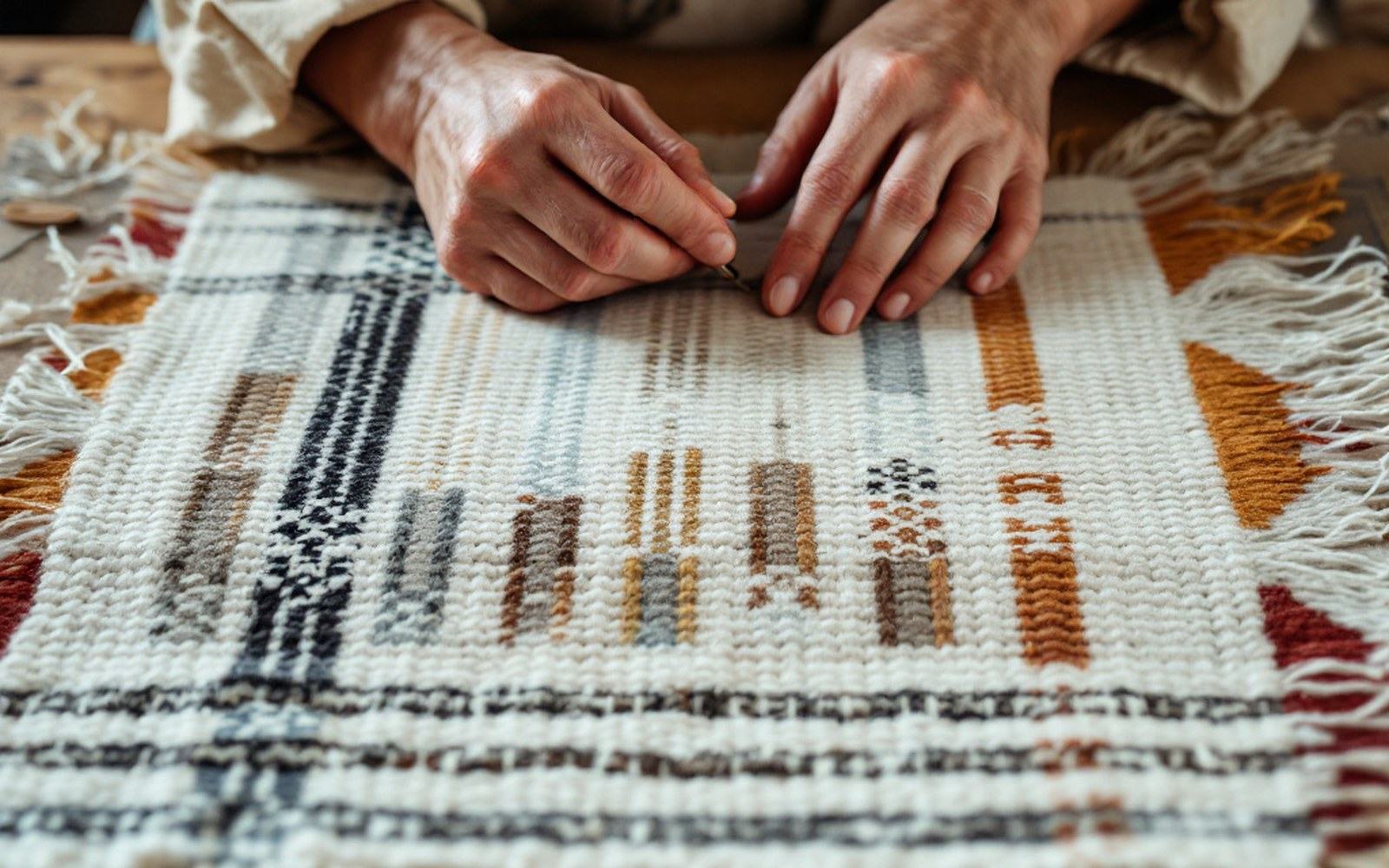
In the design vocabulary of the Navajo, the figure that appeared in weaving and silverwork was known as the whirling log, a form distinct in name, orientation, and ceremonial reference from any shape used on another continent. The tradition connects it to a narrative in which a figure travels on a log down a river, and the arms of the form trace that motion.
It appeared in sand paintings used in healing ceremonies, and weavers incorporated it into blankets and rugs from at least the late nineteenth century, when the figure became visible to outside collectors and traders. Its presence in the weaving record is well documented.
Among the Hopi, whose pottery and basketry traditions are among the most formally continuous in the region, the form appeared as a directional marker and as an element in designs organized around movement and the four cardinal orientations. Papago and Apache craftsmen used it in their own textile and basket-weaving traditions, each with specific formal conventions governing how the figure was turned and where it sat within a composition.
The four traditions were not identical, and the figure did not mean the same thing across all four — what it shared was its geometry, not its symbolism. The declaration's signatories were clear that they were acting because of the geometry, because that was what outside observers could see.
The figure in the longer record of the American Southwest
The form has a deep pre-contact history in the region. It appears on ceramics from the Ancestral Puebloan sites of the Colorado Plateau, on painted pottery associated with the Hohokam culture of the Sonoran Desert, and on rock art across the Four Corners area.
Archaeologists working in these regions in the early twentieth century documented it as a recurring motif across several centuries, well before any outside influence could account for its presence. It was not borrowed; it developed within the visual systems of the region and persisted through the enormous shifts in material culture that followed European contact.
By the late nineteenth and early twentieth centuries the figure appeared commercially. Trading posts sold Navajo rugs that included it to Anglo-American buyers who found it decorative and sometimes considered it lucky — a reading that was neither Navajo nor informed by Navajo ceremony, but which the market sustained.
The figure appeared on railroad promotional material, on tourist goods, and in the illustrated catalogs that brought Southwestern craft to eastern buyers. That commercial visibility is part of what made the 1940 decision legible to a non-Native audience: the shape had been circulating in mainstream American consumer culture for decades, and its sudden disappearance from new work was something retailers and buyers could notice and report.
A decision about a shape, stated plainly
The declaration did not attempt to explain the full ceremonial depth of the whirling log or its analogues among the other three nations. It did not need to. The craftsmen stated that the figure they had used was their own, that it had its own meaning within their traditions, and that they were choosing to stop using it because of what was being done with a visually similar shape through appropriation elsewhere.
That distinction — between the figure as they had used it and the figure as it was appearing in a different context on another continent — was the entire basis of the declaration. The signatories were not confused about their own tradition; they were responding to a situation in which the geometry had become a liability regardless of its source.
The declaration is sometimes treated as a moment of loss, but it is more accurately read as an exercise of authority. The craftsmen controlled what went into their work. They assessed the situation and they acted on that assessment. The objects they had already made remained what they were; pieces woven or stamped before 1940 sit in museum collections and are catalogued with their correct provenance and their correct cultural context. What the declaration governed was new production, and that was within the craftsmen's power to govern.
What the record holds
Museum collections are the primary archive for this history. Textiles, silver work, and ceramics produced before 1940 carry the figure in its Southwestern forms, documented with collection dates that place them firmly in the pre-declaration period.
Scholars working on Southwestern design history — drawing on excavation reports, trader records, and the holdings of institutions including the National Museum of the American Indian — have treated the 1940 declaration as a datum in that history: a point at which the archaeological and the contemporary intersected, and craftsmen made a documented response.
The figure's presence in the pre-contact archaeological record of the Southwest means it belongs to that record regardless of what happened in 1940. It is documented across Ancestral Puebloan ceramics as a design element continuous across centuries, and that continuity does not depend on its post-1940 status in craft production.
The four nations' declaration closed one chapter of its use. The archaeological chapter remains open, and the excavated material continues to be studied for what it tells us about how the form moved through pre-contact visual systems — without reference to anything that happened elsewhere.