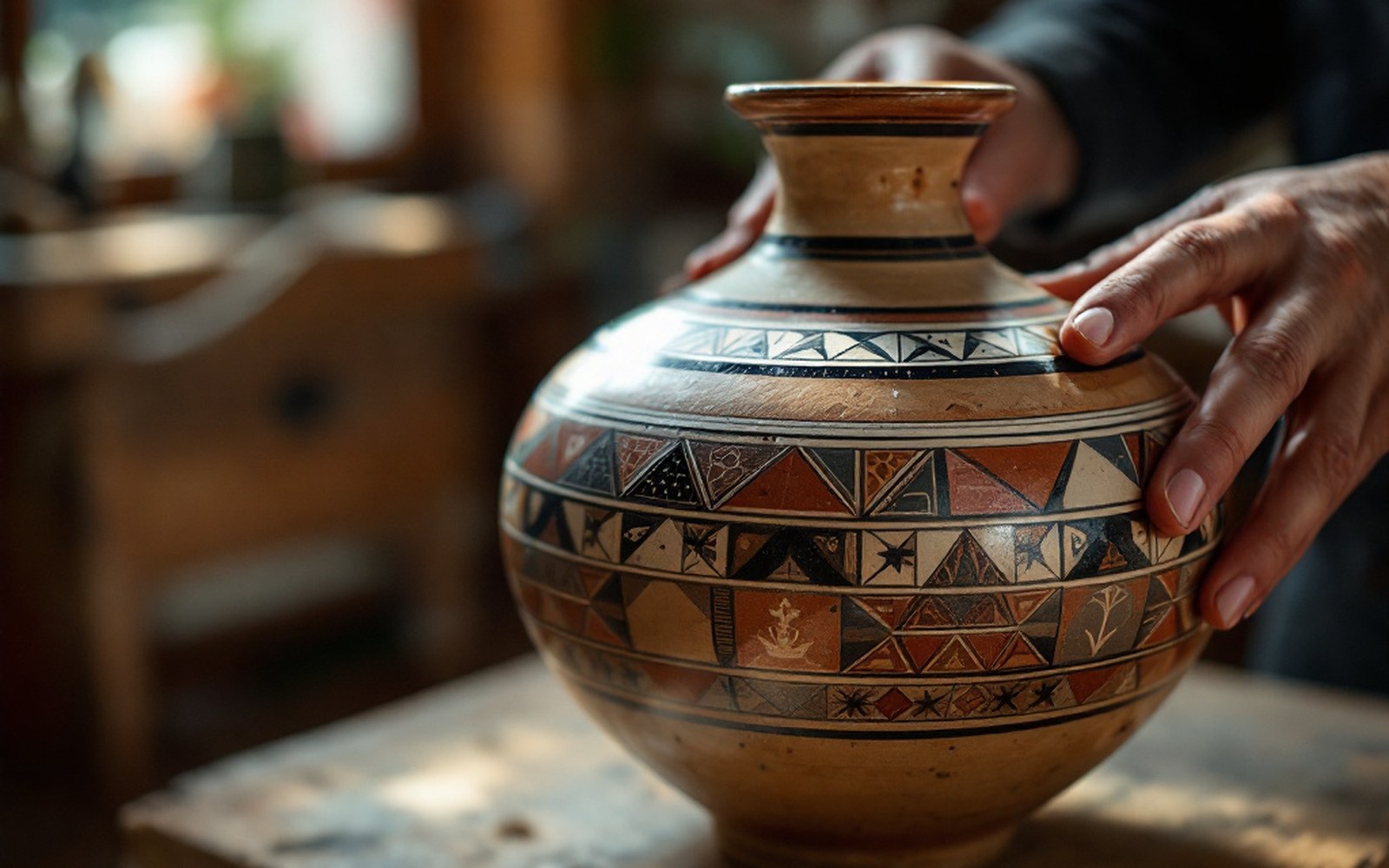
The meander
Fishbourne, West Sussex
The same repertoire at the northern edge of the empire, laid by craftsmen working to the same pattern books.
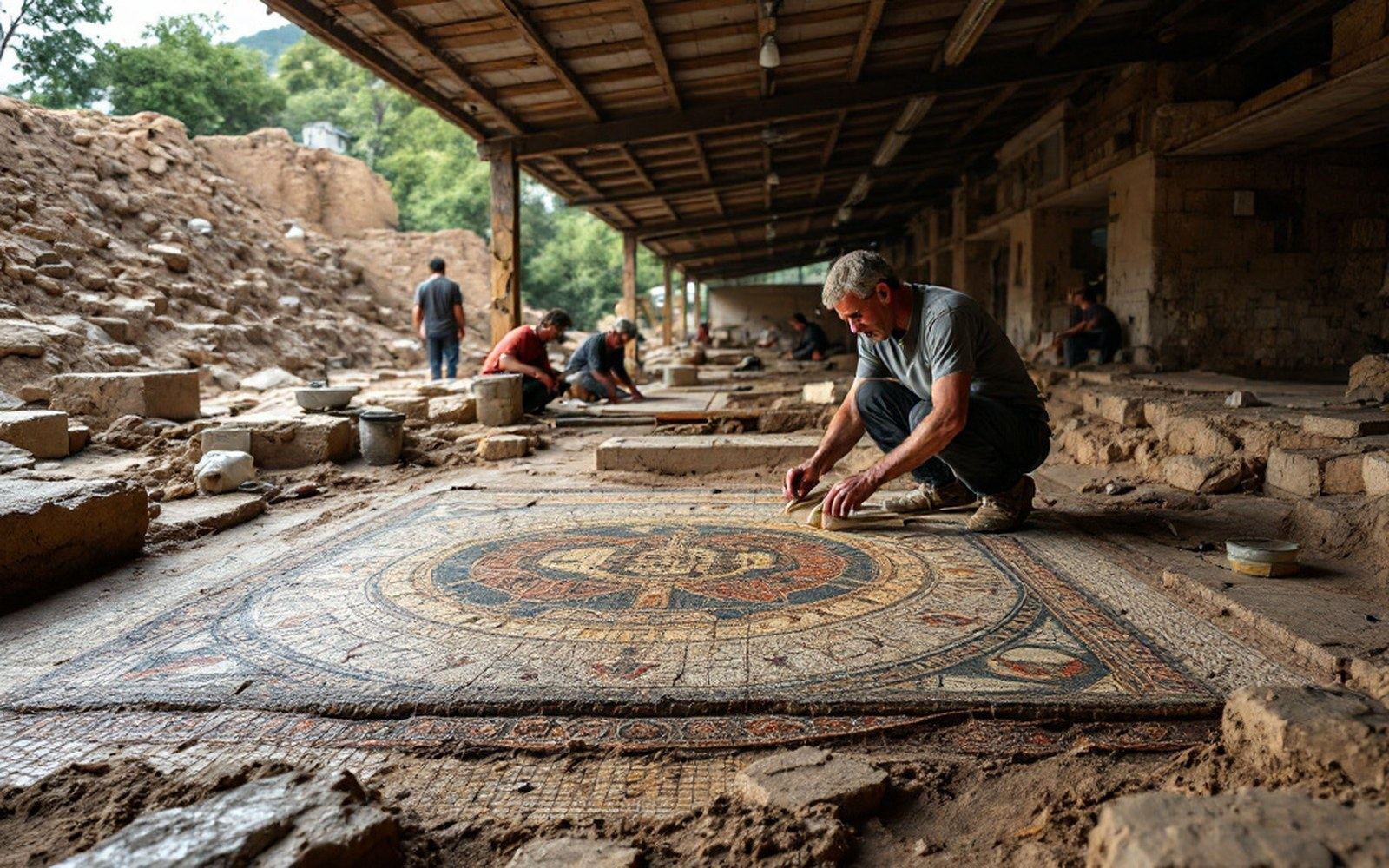
The same repertoire at the northern edge of the empire, laid by craftsmen working to the same pattern books.
The empire's pattern book at the edge of the known world
Roman Britain was a province built to look Roman, and nowhere makes that plainer than Fishbourne Palace. Constructed in the late first century CE on the Sussex coastal plain, it is among the largest Roman residential buildings yet excavated in Britain — and its mosaic floors carry the same geometric vocabulary that tiled villas from Sicily to Syria.
The palace is best known for its dolphin mosaic in Room W8, but the floor series as a whole is a systematic lesson in how Roman craftsmen — tesselatores working to shared pattern books — deployed the meander as structure. The Greek key, as it is sometimes called in English, functions here as a border, a divider, a framing device: a line that turns on itself at regular intervals, generating an interlocked running pattern from a single repeated unit.
When that unit is resolved into a closed square spiral and four such spirals are joined at their arms, the result is precisely the hooked cross that appears on Geometric-period Athenian pottery centuries before the palace was built.
At Fishbourne the figure appears in its banded, continuous form rather than as a discrete motif, though the underlying geometry is identical. Barry Cunliffe's excavations, which began in 1961 and whose full publication by the Society of Antiquaries of London remains the standard reference, recorded the floor schemes room by room. The meander borders run in black-and-white tesserae, the contrast sharpening the angular logic of the design.
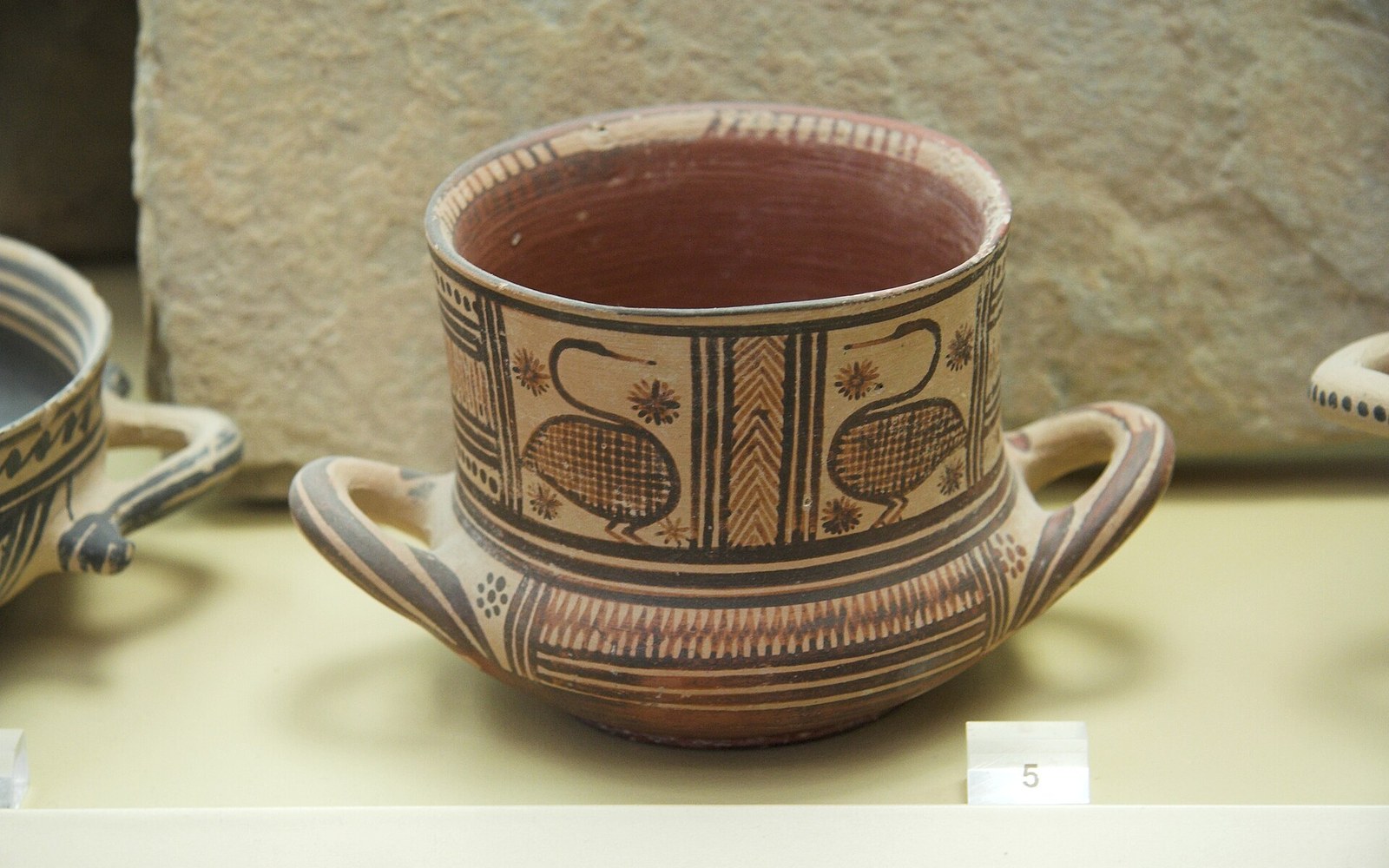
What is striking is not innovation but fidelity: craftsmen presumably trained in a Mediterranean workshop tradition produced, on the rain-grey edge of the empire, floors indistinguishable in grammar from those at Piazza Armerina in Sicily or the townhouses of Pompeii.
The palace was damaged by fire in the late third century and never fully rebuilt. It was rediscovered in 1960 when a water main was being laid — the kind of accident that has opened most of Roman Britain to view. The floors that survived are now protected in situ under a purpose-built museum, run by the Sussex Archaeological Society, where the meander borders can be read at close range, laid tile by tile in a pattern whose logic has not changed in two and a half millennia.
The craftsmen who set those tesserae were not thinking about symbols. They were thinking about the geometry of the meander border — a system of interlocking right-angle turns that produces order, that resists the eye's wish to stop, and that happened, along one of its combinatorial paths, to produce this figure.