The meander
Geometric Athens
The pottery of the period is named for its ornament, and the ornament is built from repeated right angles.
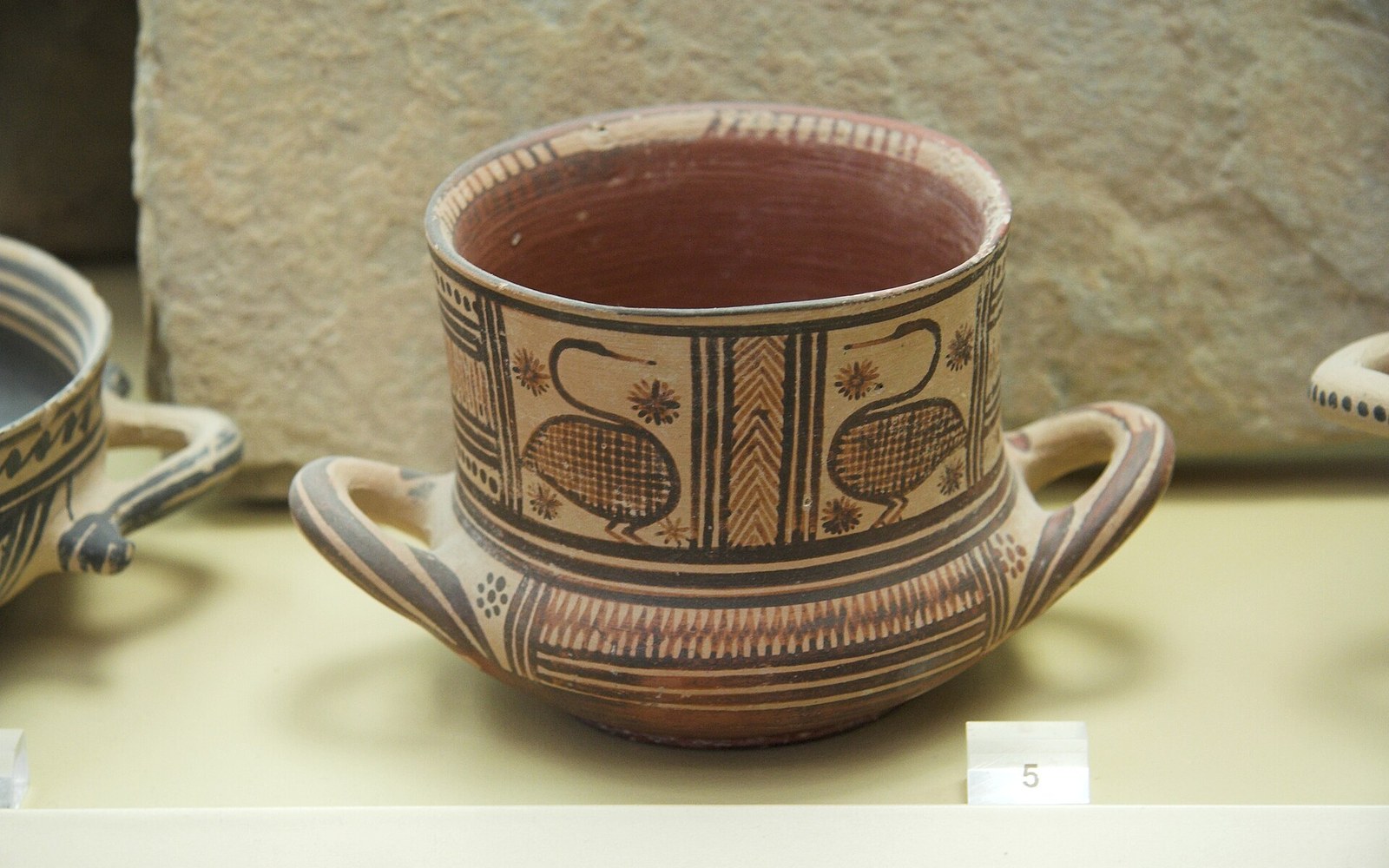
The pottery of the Geometric period is named for its ornament, and at the centre of that ornament is a figure built from the right angle repeated.
The Dipylon Workshop and Its Register
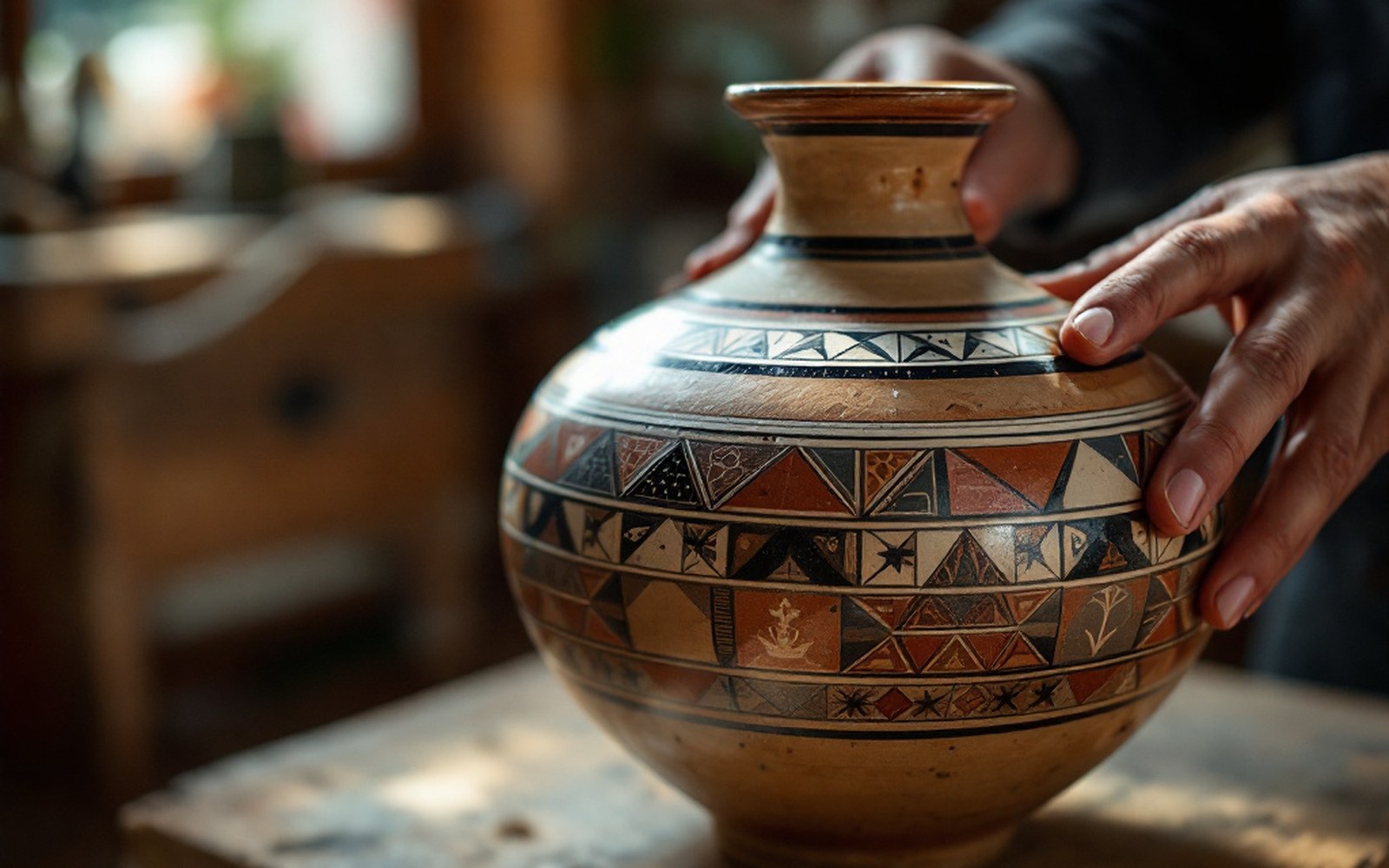
Athens in the ninth and eighth centuries BCE produced pottery unlike anything that had preceded it. The style we call Geometric emerged gradually from the Protogeometric wares of the preceding century, but by around 800 BCE it had become something systematic — a decorative logic covering the entire surface of a vessel in tight horizontal registers. The name was not an ancient one; it was given by art historians to describe what they saw: ornament derived from the geometry of the compass and the straight edge, with almost no concession to organic form.
The workshops clustered around the Dipylon gate, the great double gateway in the Kerameikos district of Athens, produced the most ambitious pieces. The Dipylon amphora and the Dipylon krater — both now in the National Archaeological Museum in Athens — stand roughly a metre and a half tall and were made as grave markers rather than domestic vessels. Every centimetre of their surface is organised. Bands of hatched triangles, lozenges and zigzags alternate with wider registers carrying figural scenes, and running through it all, knotting the composition together, is the meander.
What the Meander Does
The meander — the Greek term maiandros, drawn from the winding Maeander river in Anatolia — is a continuous line that turns at right angles and doubles back on itself without ever closing or terminating. On a Geometric pot it functions as a border, a framing device and, in its denser forms, a field filler.
It is drawn on a strict grid: every turn is ninety degrees, every stroke the same width as the space between strokes. The result has no visual rest. The eye follows the line and cannot predict where it will go next, yet the pattern is completely regular. That tension — between variety and order — is the formal achievement the Geometric painters were after.
It is within this ornamental system, on Geometric pottery and bronzework, that the swastika appears as one recognised unit. It is not a special mark or a religious symbol in this context; it is a member of the same geometric family as the meander, the running spiral and the hatched triangle. All of them are built on the same right-angle grid, all of them tile the surface with the same logic.
The swastika in this setting is better understood as a closed meander — a meander that returns to its own origin and locks. The Museum of Fine Arts Boston and the Ashmolean Museum both hold Geometric pieces where the two forms appear side by side in adjacent registers, which makes the relationship between them visible without argument.
The Geometric period comes to an end in the late eighth century, when contact with the Near East and Egypt introduced curved ornament, lotus flowers and animal friezes.
The meander does not disappear — it survives into red-figure and black-figure ware as a border motif and persists in architectural ornament well into the Hellenistic and Roman periods — but the swastika, as a standard decorative unit, fades from the potter's repertoire at roughly the same moment. Its presence in the Geometric period is purely a function of the system that generated it: when the system gave way to a different decorative vocabulary, the figure was no longer called for.
An Archaeological Record
The Kerameikos cemetery in Athens, excavated continuously since the 1870s and now maintained by the German Archaeological Institute, has yielded more Geometric pottery in context than any other site. The grave goods are catalogued with their find spots, which means the chronology is reasonably secure: the swastika appears on pieces dated to the ninth and eighth centuries BCE, most densely in the mature Geometric phase, roughly 760 to 700 BCE.
What the Athenian painters meant by it — whether it carried any value beyond its formal properties — the archaeological record does not tell us. The pots do not speak to that question, and no text of the period does either. What survives is the object, the system, and the discipline with which the potters applied it.