The meander
Piazza Armerina
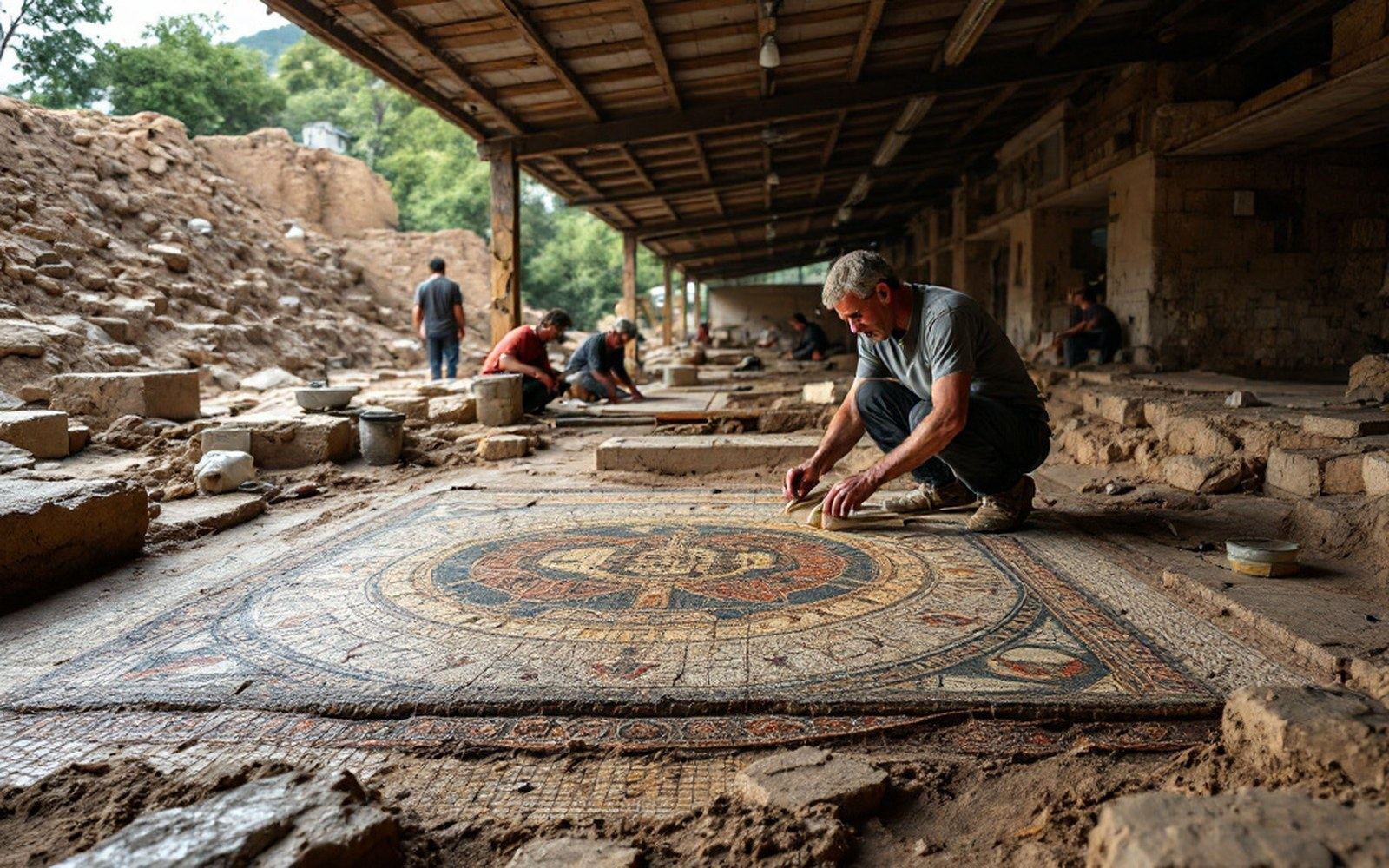
A Roman villa floor where the borders run for a great distance without a break, which is a statement about the workshop as much as the pattern.
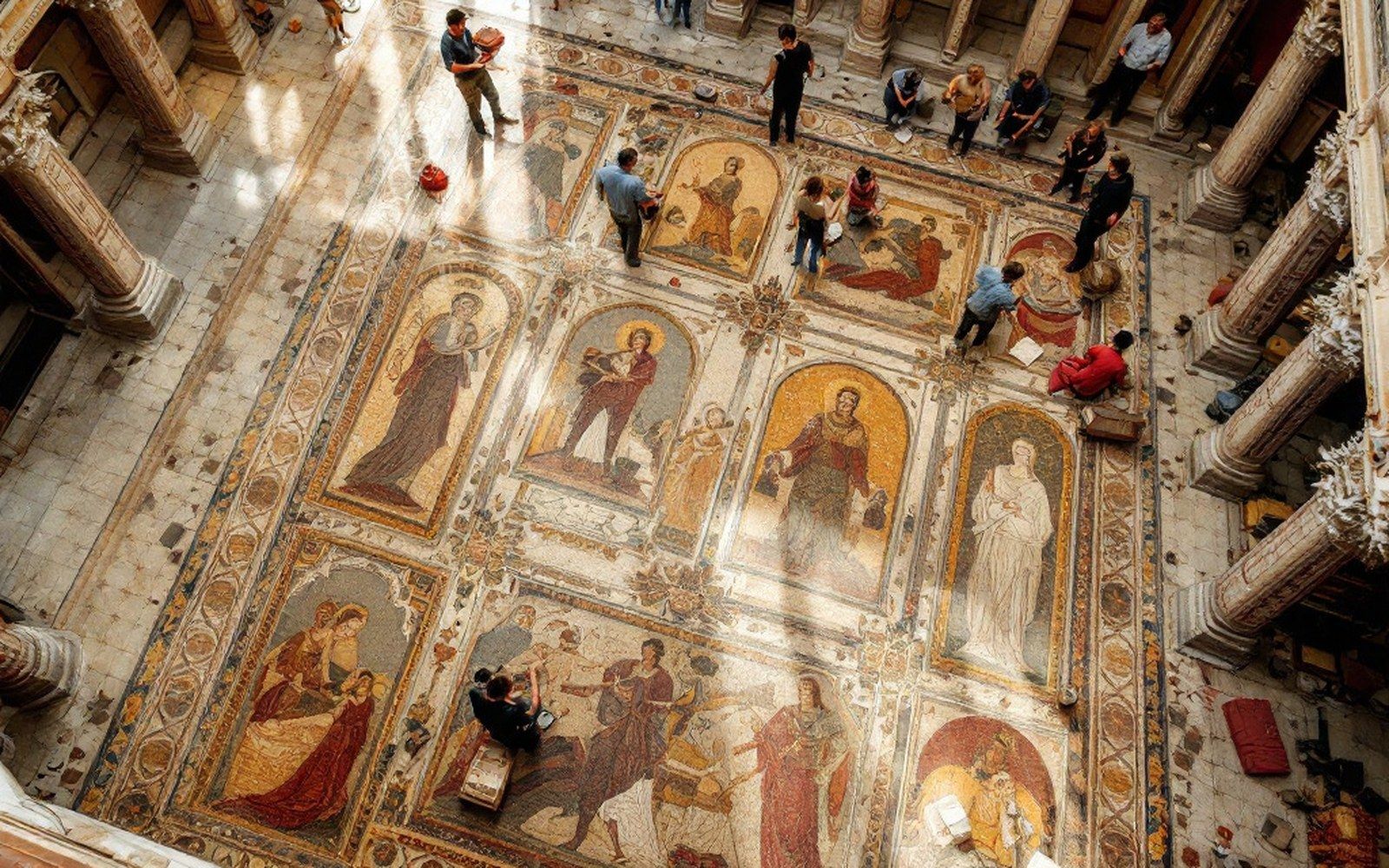
A Roman villa floor where the borders run for a great distance without a break, which is a statement about the workshop as much as the pattern.
A Roman floor that never stops turning
The Villa del Casale lies beneath the hills of central Sicily, buried under a mudslide sometime in the twelfth century and not properly excavated until the mid-twentieth. What emerged was a complex of rooms whose mosaic floors cover more than three thousand five hundred square metres — one of the largest surviving decorative programmes from the Roman world. The date most archaeologists accept for the main building phase is the early fourth century, and whoever commissioned it was not thinking small.
The figurative panels draw most visitors: the so-called "bikini girls" exercising, the great hunt corridor shipping exotic animals across the empire, the children's races with birds and chariots scaled down to a miniature key. But the borders that frame every panel, and separate each register of imagery from the next, are themselves a sustained technical statement.
The meander — the interlocking right-angle key, built from a continuous line that folds back on itself in a strict grid — runs through room after room without a break in its logic. At Piazza Armerina the meander is not a shorthand decoration but a structural language, and the mosaic workshops of the western empire understood it as one.
What the border is actually doing
A meander border does a specific thing: it creates a sealed edge, a boundary that the eye reads as inviolable, around whatever it contains. The line never crosses itself and never terminates mid-run; the only way out of a meander is to arrive back at its starting point, which in a floor border means arriving at a corner and turning cleanly.
Designing a meander for a rectangular room is therefore an act of geometry before it is an act of decoration. The craftsman has to know, before a single tessera is set, that the module will land on the corner correctly. At the Villa del Casale, across rooms of different proportions and shapes — including the distinctive triconchal triclinium at the building's southern end — the corners work. This is a workshop in full command of its system.
The module used at Piazza Armerina is not simple. Many Roman meanders are two-strand keys, but the borders here are frequently three-strand, sometimes built with colour alternation — red, cream, black — that makes each arm of the key read as a separate ribbon twisting through its neighbours.
The effect is closer to braiding than to flat ornament, and it requires a cartoon, a preparatory grid on the floor bed, to execute without error across a run of several metres. Excavation reports from the site have documented the lime mortar setting beds where the grid lines are still legible beneath the tesserae, which means the geometry can be recovered and studied.
The workshop as evidence
No ancient source names the workshops responsible for the Villa del Casale floors, and the commission itself is attributed on circumstantial grounds — the scale, the iconography, the probable date — to someone of senatorial rank, possibly connected to the imperial court at a moment when the western empire was reorganising itself politically. The attribution matters less than what the floors prove about the organisation of Roman mosaic production.
A project of this scale required teams working in parallel: figurative specialists handling the hunt corridor, geometric specialists laying the border sequences, both groups reading from the same overall design document so that their modules met cleanly at every junction. The meander borders, because they are continuous, are the seam where any mismatch would show. They do not show.
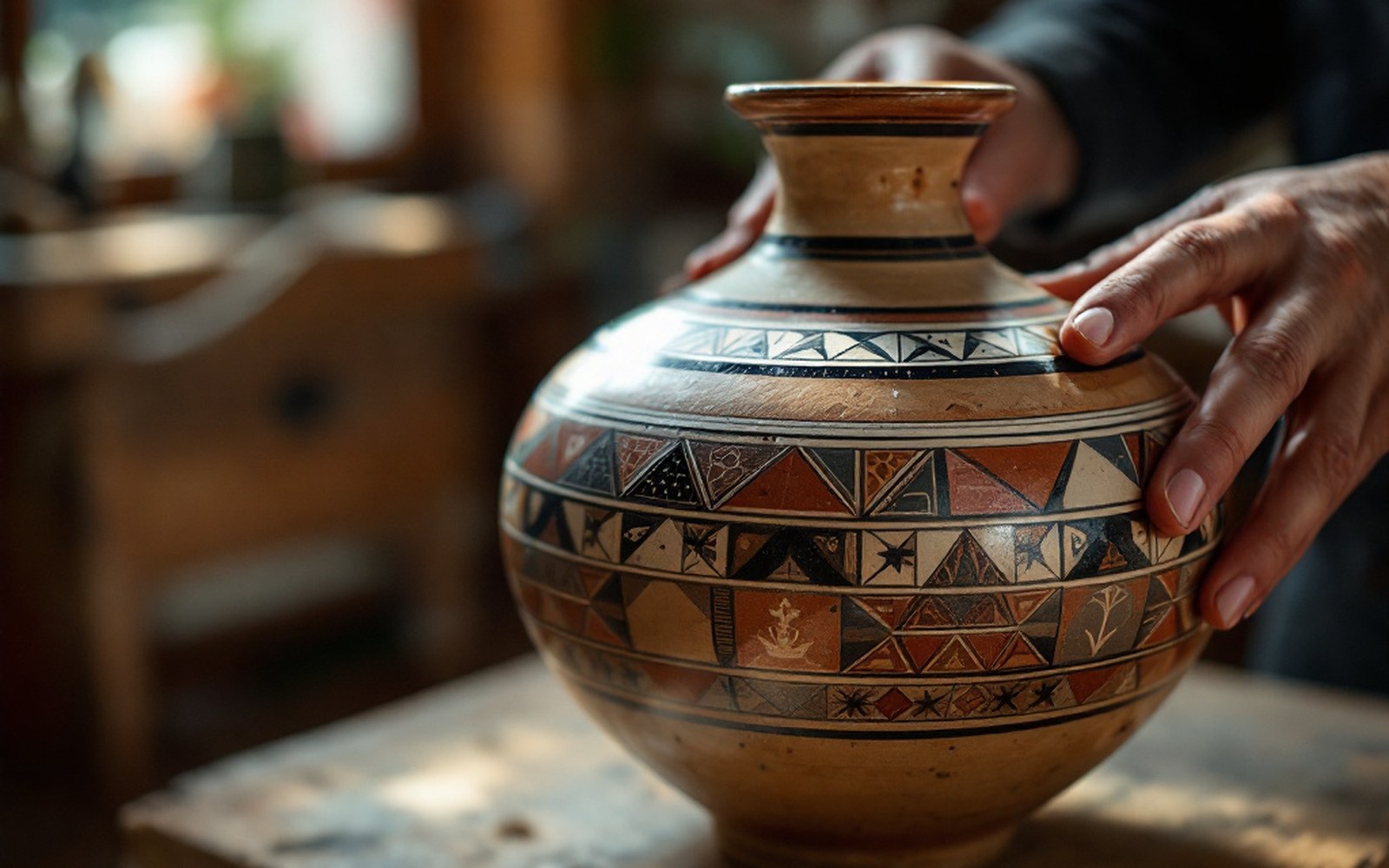
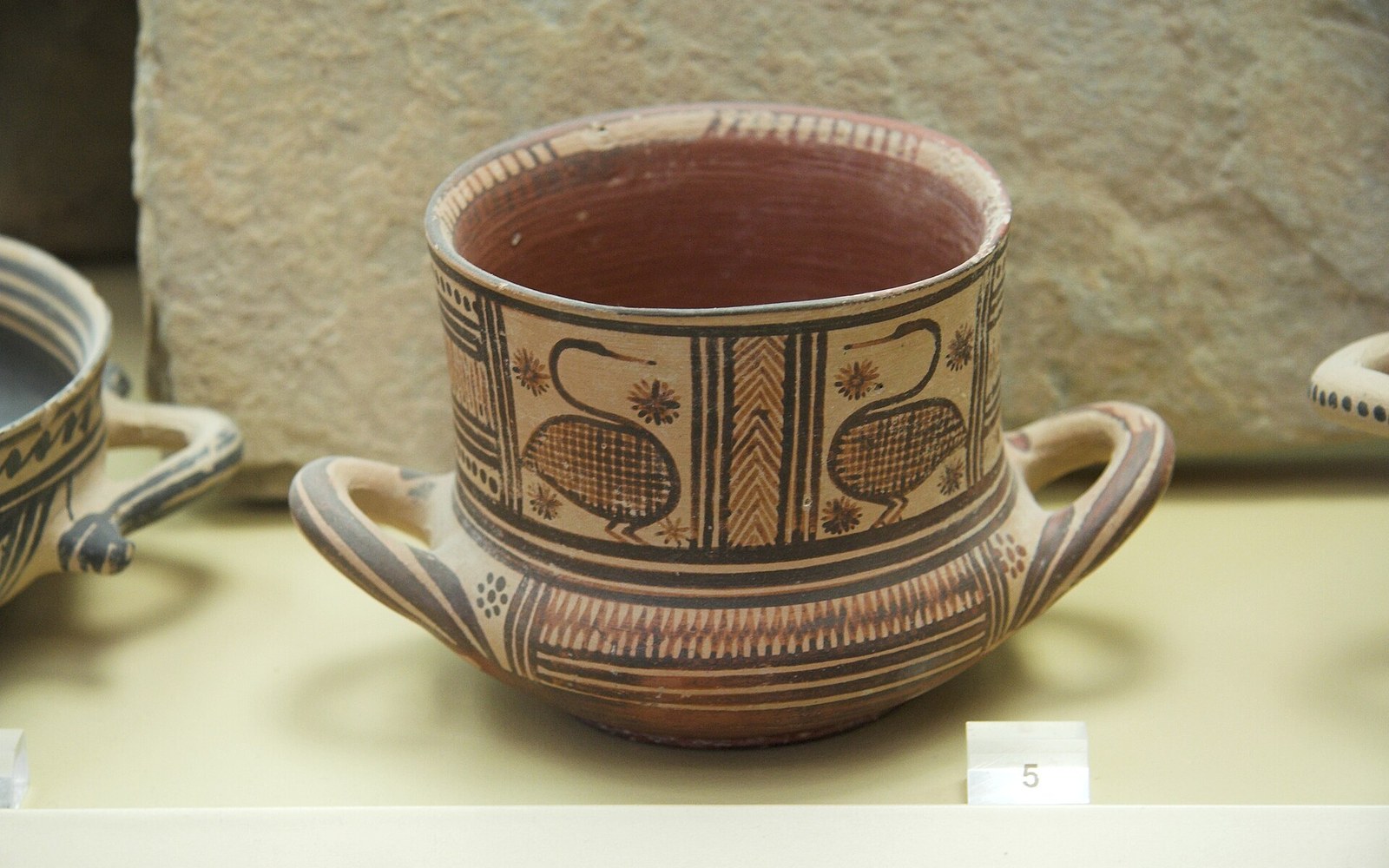
This is what makes Piazza Armerina a key site for understanding the meander as a craft object rather than simply a decorative motif. The Greek Geometric tradition established the key as a vocabulary of precision drawing on a grid, and Roman floor mosaicists inherited that logic wholesale — but they scaled it, built it in stone and glass rather than pigment, and distributed it through professional workshops that could execute it to contract across hundreds of square metres.
The villa in central Sicily is where the full consequence of that inheritance is laid out, literally, underfoot. The line turns, and turns again, and does not stop, and every turn confirms that the people who made it had counted every corner before the first stone was placed.