The meander
The Meander Border
The Greek key and its variants are drawn on a grid, and the figure appears as one term in that family rather than as a separate emblem.
Where the Greek key, the running fret, and the hooked cross all share a grid — and one form tips into a cross with bent arms
Drawing on the Grid
The meander is not a symbol in the sense that a seal or a votive tablet is a symbol. It is a pattern, generated by a rule: occupy every square on a grid by a continuous line that turns only at right angles. The Greek key — the form most people recognise from the borders of classical pottery — is the simplest resolved version of that rule, its line reversing at regular intervals to produce a stepped spiral.
Run that rule long enough, and among the shapes the grid can generate sits a cross with four arms each bent at ninety degrees. The craftsman drawing a meander border is not choosing between one emblem and another; he is choosing a path through the grid, and one of those paths is a hooked cross.
This is the essential fact about the figure's appearance in Greek and Roman decorative art. It does not carry a name distinct from the surrounding family of key patterns. It does not carry a separate mythology. It sits in the border as one resolution of the same underlying geometry that produces the spiralling key beside it, and on painted pottery, mosaic floors, and woven textiles it passes from one form to the other without ceremony, sometimes within a single frieze.
Geometric Athens and the Named River
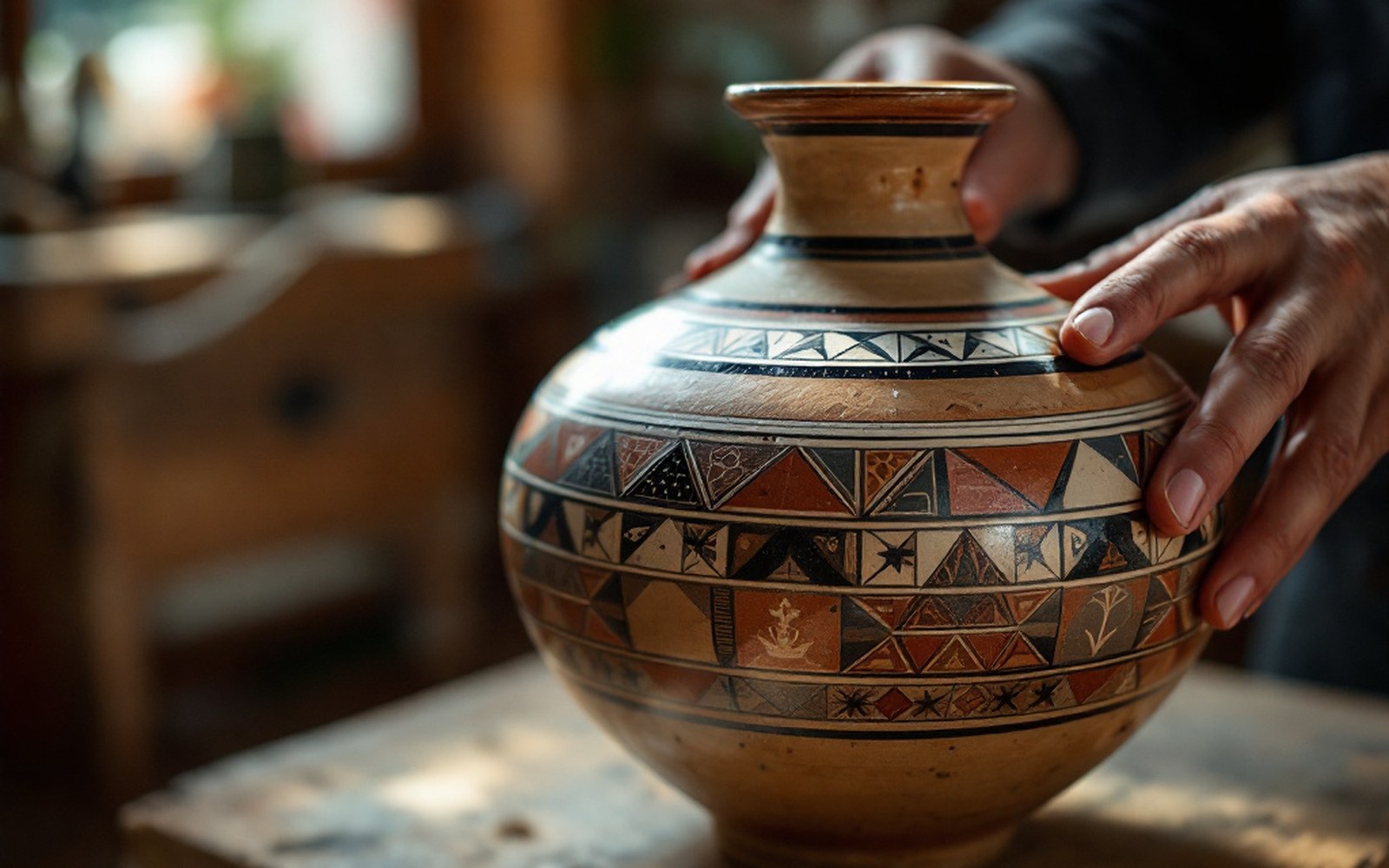
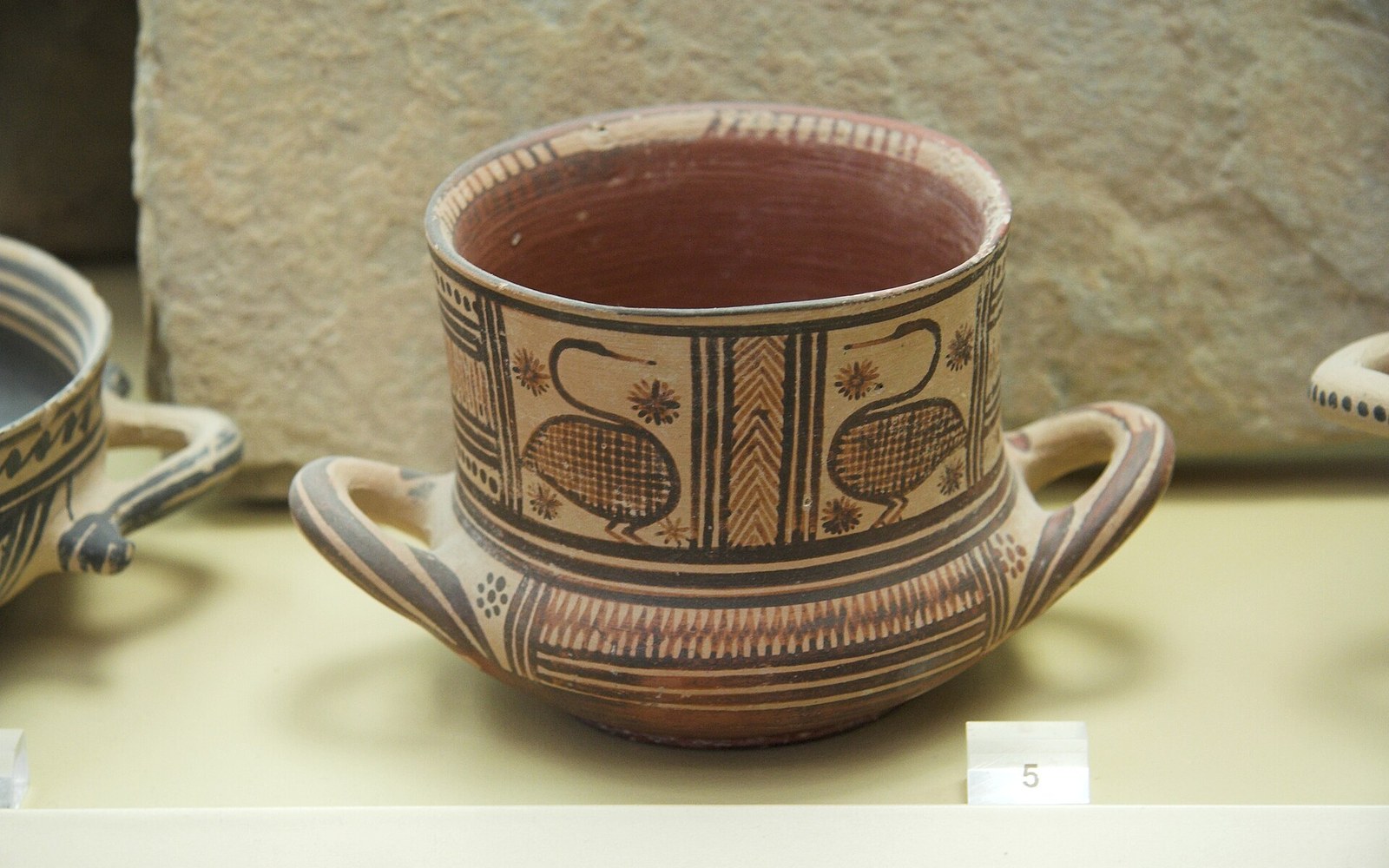
The style of ornament that organised Greek pottery during the ninth and eighth centuries BCE is named for this approach to decoration. The Geometric period takes its label from the repertoire of forms its potters used: zigzags, lozenges, concentric circles, and above all the meander. The word itself is borrowed from the Maeander River in western Anatolia — the modern Büyük Menderes — whose course winds back on itself so insistently that the Greeks used the river's name as their word for any line that doubles back, in water or in ornament.
On the great Dipylon kraters and amphorae from Athens, now held in the National Museum in Athens and in the Metropolitan Museum of Art in New York, the meander runs as a horizontal band of precisely repeated stepped spirals, dividing the zones of figured ornament.
These pots, some of them over a metre tall, were set over grave shafts as grave markers in the Kerameikos cemetery during the late ninth and eighth centuries BCE. The meander border here is funerary in context, but its meaning is spatial — it marks a register, separates a zone, holds the composition together — rather than apotropaic in any documented sense.
Within the Geometric vocabulary the hooked-cross variant appears, drawn by the same hand that draws the key. An Athenian vase painter working through the options available on a four-square grid would encounter it as a natural neighbour to the spiral meander, and both would appear in a single piece as part of the same decorative grammar. What neither the vase nor any contemporary text assigns to it is a separate name or a distinct meaning: it is a meander form, full stop.
The Roman Floor and the Long Border
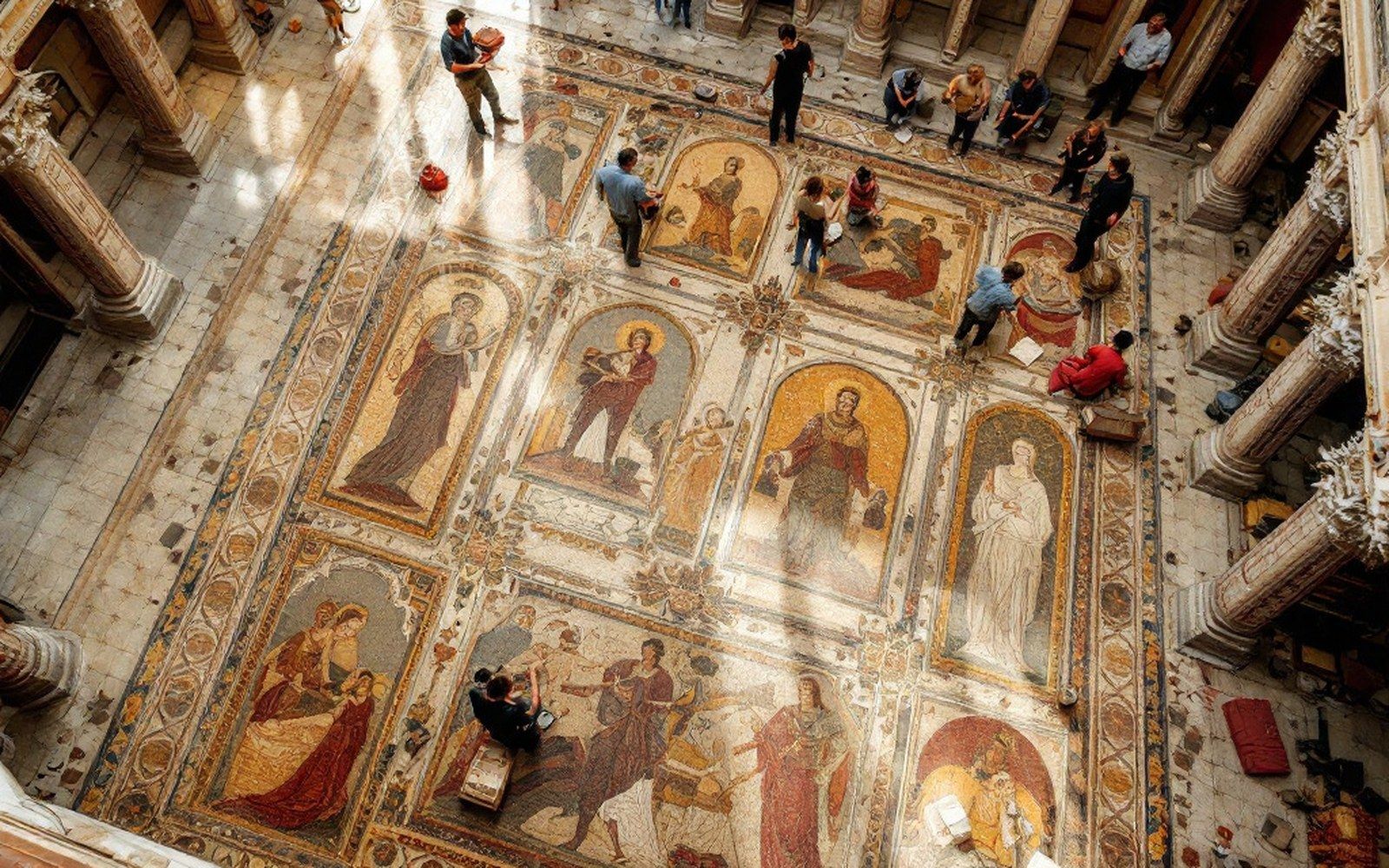
By the time Greek decorative language had passed into the Roman world, the meander border had become standard vocabulary for mosaic craftsmen working across the empire. At the Villa Romana del Casale at Piazza Armerina in Sicily, dating to the early fourth century CE, meander and key-pattern borders run for considerable distances, framing the great hunting and athletic scenes for which the villa is known.
The floor as a whole is among the largest and best-preserved Roman mosaic complexes in existence, and its border work shows the full repertoire: simple keys, running spirals, and the hooked-cross variant woven into the sequence without distinction.
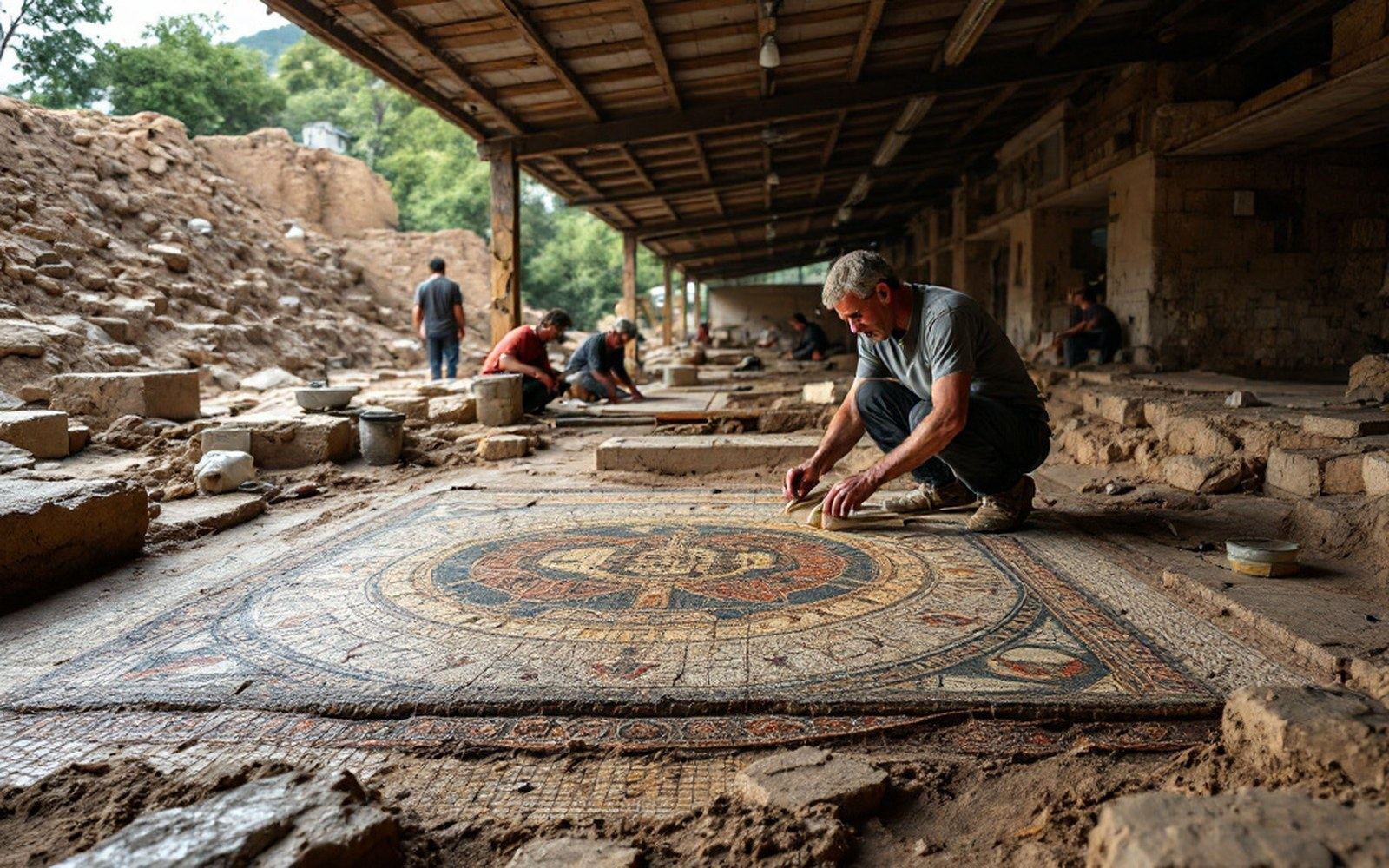
At Fishbourne in West Sussex, the late first-century CE Roman palace excavated from the 1960s onward, the mosaic floors again deploy meander borders as structural framing devices. The craftsmen at Fishbourne were working within a tradition whose design vocabulary was established and transferable — the same pattern books, the same grid, the same family of forms — whether the floor was being laid in Sicily, in Britain, or anywhere else within the Roman world. The borders at Fishbourne are documented in the excavation reports held by the Sussex Archaeological Society and the on-site museum.
In none of these contexts does any ancient source distinguish the hooked-cross meander from its neighbours in the border, give it a separate name, or treat it as carrying a meaning different from the key it sits beside. The distinction is a modern one, applied retrospectively.
One Family, One Grid
The point that matters for any reader approaching this material is methodological as much as historical. When art historians and archaeologists describe the hooked-cross form on a Greek pot or a Roman floor, they are describing a meander variant, and they situate it within the meander family because that is where the evidence situates it.
The grid that generates a key pattern also generates a hooked cross; the same hand that lays tesserae in a stepped spiral can, by continuing the path a few squares further, arrive at the four-armed figure. These are not two separate things that happen to look alike. They are two outputs of the same constructive rule.
That rule operated independently in other parts of the world — in the Indus Valley, where steatite seals from Mohenjo-daro carry the figure in a context entirely separate from anything Greek or Roman, and in the American Southwest, where it appeared in weaving and silverwork with its own name and its own tradition.
The convergence is geometrical: a grid of squares, a rule about right-angle turns, a finite number of resolutions. What the figure meant to the people who used it was determined by their own tradition, their own vocabulary, their own ritual or decorative context — not by the shape alone.
In the Greek and Roman world, that context is the border. The meander runs along the edge of the vessel, the floor, the wall. It frames and it divides. One of the paths the line can take through the grid produces a cross with bent arms, and when it does, the border continues without a break, turning the next corner, generating the next figure, covering the next square on the grid — because the rule has not changed, and neither has the craftsman's intention.