The four gatis
Kankali Tila, Mathura
An excavated Jain site whose sculpture and votive tablets are among the earliest dated material evidence in the tradition.
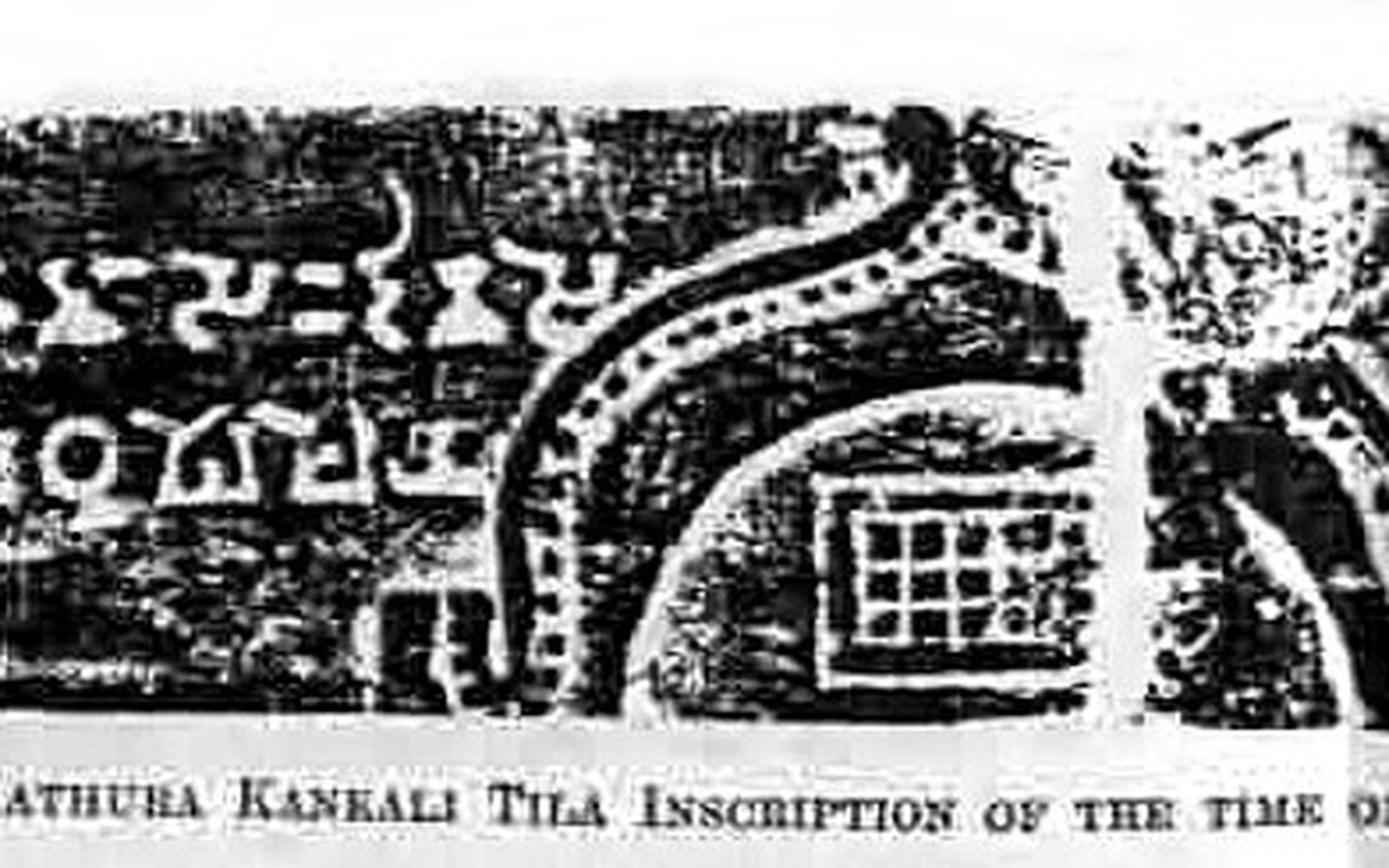
An excavated Jain site whose sculpture and votive tablets are among the earliest dated material evidence in the tradition.
The mound that held a millennium of Jain devotion
Kankali Tila is a low earthen mound on the western edge of Mathura, in Uttar Pradesh, and it rewarded excavation with one of the most concentrated bodies of early Jain sculptural evidence anywhere in the subcontinent. The site takes its name from a local goddess, Kankali, whose small shrine sat on top of the debris of centuries of Jain use below.
What lay underneath was a sequence of votive deposits, architectural fragments, railing pillars, crossbars, āyāgapaṭas — votive tablets — and inscribed donor records stretching from roughly the second century BCE into the twelfth century CE, a span of well over a thousand years of continuous religious activity at a single location.
The excavations that brought this material to scholarly attention were carried out by Anton Führer between 1888 and 1891, working under the Archaeological Survey of India. Führer's methods were rough by later standards and the stratigraphy was not fully recorded, but the sheer quantity and quality of what emerged was undeniable.
The Lucknow State Museum received the bulk of the finds; a portion entered collections in Europe, including the Victoria and Albert Museum in London, where several Mathura Jain pieces are now catalogued. The site is closely associated with the ancient Jain sacred presence at Mathura, a city that the tradition identifies with Jina Nemi, the twenty-second Tīrthaṅkara, and which appears in early Jain canonical texts as a centre of the faith.
What the tablets and carvings actually show
The āyāgapaṭas — rectangular stone tablets carved for votive presentation — are the pieces that most directly concern the history of auspicious imagery in the Jain tradition. Several examples from Kankali Tila, now datable by their inscriptions to the Kuṣāṇa period, first and second centuries CE, carry a mark at their centre or along their borders as part of a set of auspicious figures.
On some tablets the central field holds a Jina figure or a stūpa, surrounded by symbols arranged in a register: a śrīvatsa, a svastika, a nandyāvarta, a pūrṇakalaśa, a fish pair. This is the vocabulary of the ashtamangala — the eight auspicious things — and Kankali Tila provides some of the earliest stone evidence that the svastika operated within that set in Jain visual practice.
The svastika on these tablets is carved with arms of equal length, rotating to the right, with serifs at the arm ends that are sometimes plain stubs and sometimes more fully developed hooks. It appears in low relief against a plain ground, treated with the same degree of care as the other symbols beside it. Its scale and placement within the field leave no doubt that it was understood as one term in a deliberate grammar of auspiciousness, not a background ornament.
The Jain teaching that links the four arms explicitly to the four gatis — the four states of rebirth, divine, human, infernal, and animal — into which a soul may be born is a doctrinal reading attested in later didactic literature, but the visual insistence on the four equal arms as a structural principle is already visible in the Mathura carvings.
The inscriptions on many of the Kankali Tila pieces are among the most valuable features. Donor records name lay men and women, monks, nuns, and guild members; they specify the image or object donated, the occasion, and sometimes the sectarian affiliation.
This is documentary evidence of how the site functioned: not as a monastic retreat but as a location where merchant families and craft guilds presented votive objects to accumulate merit. The svastika and the other auspicious marks on those objects were therefore embedded in a social as well as a doctrinal practice — the marks were part of what made a gift fit for presentation.
Stone, inscription, and the scholarly record
The material from Kankali Tila entered the scholarly record most rigorously through the work of Georg Bühler, who examined the inscriptions in the late nineteenth century, and through the systematic publication of Jain sculptural material from Mathura by subsequent scholars working with the Lucknow collection.
The inscriptions are in Brāhmī script, the standard epigraphic vehicle of the period, and their readings have been refined over more than a century of work. The British Museum's collection of Indian sculpture holds comparative Mathura material that allows the Kankali Tila pieces to be read within a broader regional production, though the core of the Kankali Tila corpus remains in Lucknow.
What the site demonstrates, taken as a whole, is that by the early centuries CE, Jain communities in Mathura had a sophisticated material culture organised around a shared set of auspicious figures, that those figures were reproduced in stone with enough regularity to have constituted a canon, and that the svastika was a stable and recognisable member of that canon.
This is not an inference from a single object; it is a pattern visible across dozens of pieces from a single excavated site, supported by inscriptional evidence that fixes approximate dates and names real donors. For the history of the mark in Jain practice, Kankali Tila is load-bearing evidence.
The site itself is no longer productive of new finds. It was heavily disturbed in the nineteenth century and has not yielded significant new material since the principal excavation.
What survives is the museum corpus — objects scattered across Lucknow, Mathura's own Government Museum, and institutions in Europe — and the published catalogue record. The Archaeological Survey of India's account of Mathura antiquities remains the entry point for readers who want the site's physical context: the mound's dimensions, the depth of its deposits, the sequence of structural remains that Führer uncovered, and the architectural members — railing pillars in the spotted red sandstone characteristic of Mathura carving — that indicate the presence of substantial Jain shrines well before the Common Era.
Kankali Tila matters not because it is the only Jain site with auspicious imagery, but because it is the most densely documented early one. The inscribed donors are real, the dates are argued from real epigraphic evidence, and the marks are carved in stone that can be handled and measured. For a tradition whose doctrinal literature on the svastika is sometimes difficult to date, the carvings at Mathura provide a fixed point: here, at this place, in this period, the mark was used this way, by these people, for these purposes.