The four gatis
Palm leaf at Patan
Manuscript libraries preserve the mark at the head of texts, which dates its use in writing rather than in stone.
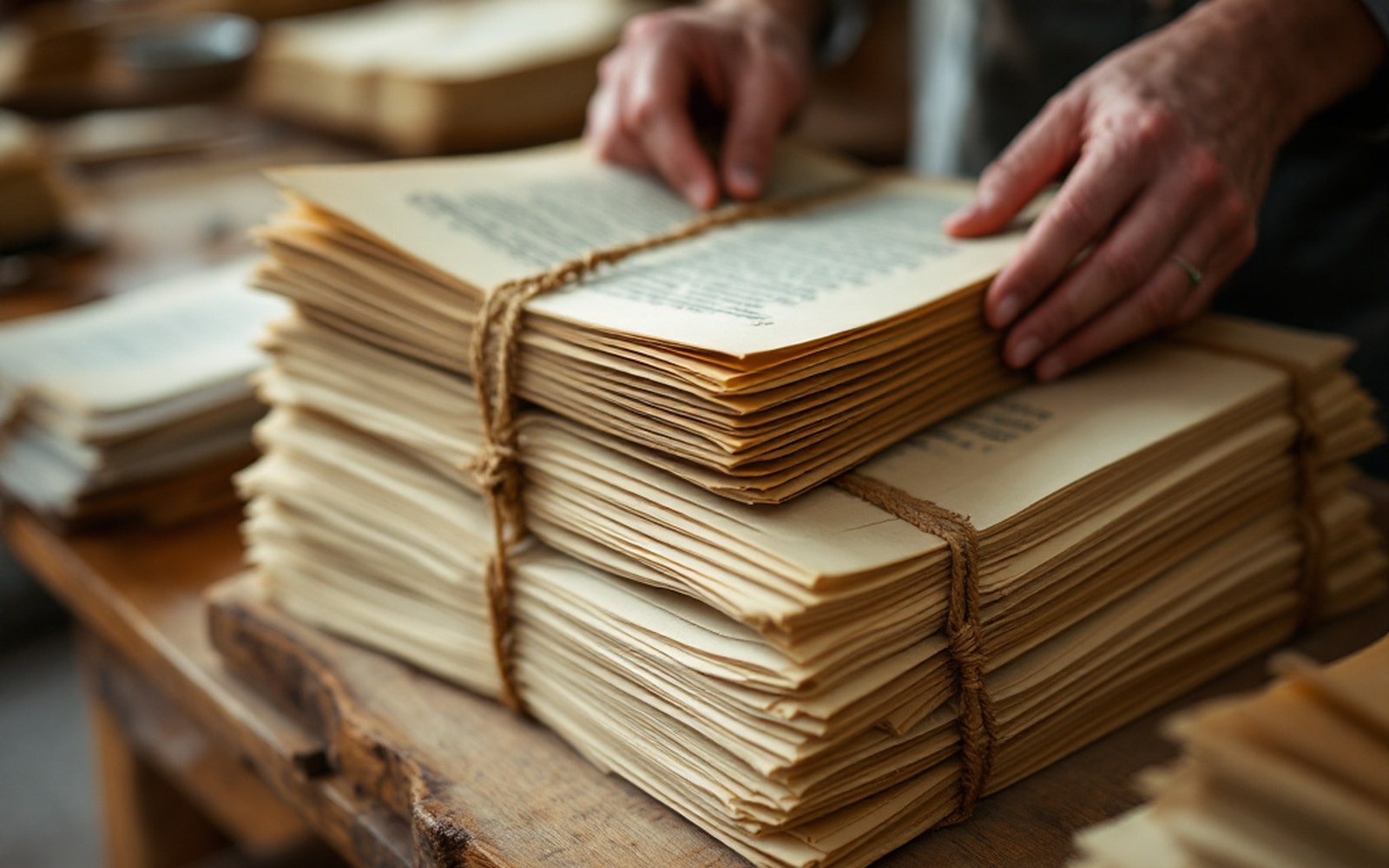
Manuscript libraries preserve the mark at the head of texts, which dates its use in writing rather than in stone.
The library that dates the mark
Patan, in northern Gujarat, holds one of the densest concentrations of Jain manuscript libraries in the world. The city's bhandars — manuscript repositories attached to temple complexes — have accumulated palm-leaf and paper texts over more than a millennium, and among the oldest surviving examples, the opening folio almost invariably carries the same form: four arms turning from a central point, drawn in the margin or set immediately before the first word of the text.
This is the mark not in stone, not woven into a relief panel, but inscribed in ink on a material that perishes — which makes its survival at Patan an index of just how carefully these libraries were maintained.
The importance of Patan for this question is precisely chronological. Scholars working on the Hemachandracharya Jain Knowledge Temple collection — one of the great bhandars of the city — have examined colophons, the scribal notes that close a manuscript and sometimes record the year of copying.
Where a colophon is dateable, the opening mark can be placed in time with a confidence that archaeological stratigraphy rarely allows. Palm-leaf Jain manuscripts in Western India belong to a scribal tradition that was already old when the earliest surviving examples were made, and the presence of the mark at the head of a text tells us it was considered essential — not decorative but protective, an invocation before the sacred words began.
What the mark does at the opening of a text
In Jain practice the mark carries a specific doctrinal weight that separates it from a merely ornamental device. It appears as one of the ashtamangala — the eight auspicious things recognised across Jain tradition — and its placement at the head of a manuscript is therefore a consecration of the act of reading, not simply a scribal habit. The scribe who drew it before writing the first syllable was performing something closer to a ritual gesture than a typographic convention.
The arm configuration familiar from Jain sources is the one in which the hooks turn clockwise, though both orientations appear in the manuscript record and the distinction does not carry the same significance it does, for instance, in Tibetan Bon practice. What the Patan manuscripts make clear is that the mark preceded the text in the same way that a spoken benediction precedes recitation: it set the frame within which the words were to be received.
The gati reading — in which the four arms stand for the four states of rebirth that Jain cosmology describes — was current among copyists working in this tradition, and several illustrated manuscripts pair the mark at the opening with cosmological diagrams further inside the text, so that the same figure that opens the folio reappears, elaborated, in the doctrinal content the text carries.
Palm leaf as a medium is itself significant. Steatite seals survive because stone survives; Kankali Tila at Mathura yielded votive tablets because sandstone survives. Palm leaf does not survive without deliberate preservation — it is vulnerable to insects, moisture and simple neglect.
That the Patan bhandars preserved thousands of folios bearing this mark across centuries is a record of institutional continuity as much as of religious devotion. The Jain community's manuscript culture in Gujarat represents one of the most sustained acts of textual preservation in South Asian history, and the mark at the head of each text was part of what that preservation was understood to protect.
The palm-leaf record at Patan thus adds a dimension that stone cannot: it places the mark inside a living scribal practice, repeated by hand, manuscript after manuscript, across generations of copyists who understood exactly what they were drawing and why they drew it first.