The four gatis
The Eight Auspicious Things
It appears as one of a set of eight, and the set is what gives it its position in the tradition.
In Jain ritual and art, no mark stands alone — it belongs to a set of eight, and that membership is precisely what confers its meaning.
The Ashtamangala and Its Logic
The Sanskrit compound ashtamangala — ashta, eight, mangala, auspicious — names a grouping that appears across several Indian religious traditions, but the Jain version has its own fixed contents and its own theological rationale. In Jain usage the set typically includes the svastika, the srivatsa, the nandyavarta, a shallow dish or lamp stand (vardhamanaka), a throne (bhadrasana), a water pot (kalasha), a mirror (darpana), and a pair of fish (matsya-yugala).
Each item signals something desirable — purity, prosperity, the presence of a liberated soul — and the eight together form a complete statement about the state of blessedness. The svastika does not float free of this company. It is the first of the eight, but it earns that position because the others surround and complete it.
The grouping is not decorative convention. In Jain cosmology, the four arms of the mark correspond to the four gatis, the four states into which a soul may be reborn — as a human, a heavenly being, a hellish being, or a creature of the animal and plant world.
Above those four arms, three dots and a crescent with a final dot above it gesture toward the fifth state, liberation (moksha), which lies beyond the cycle entirely. A single mark pressed onto a page or etched into a temple wall is therefore already a diagram of the entire Jain universe of rebirth and release. The seven objects that accompany it in the ashtamangala reinforce this framing from different angles.
Where the Set Appears
The ashtamangala is not an abstraction confined to texts. It appears on votive tablets, on the walls and ceilings of Jain temples, on manuscript covers, and in the ritual arrangements assembled before an image of a Tirthankara — one of the twenty-four liberated teacher-figures of Jain tradition.
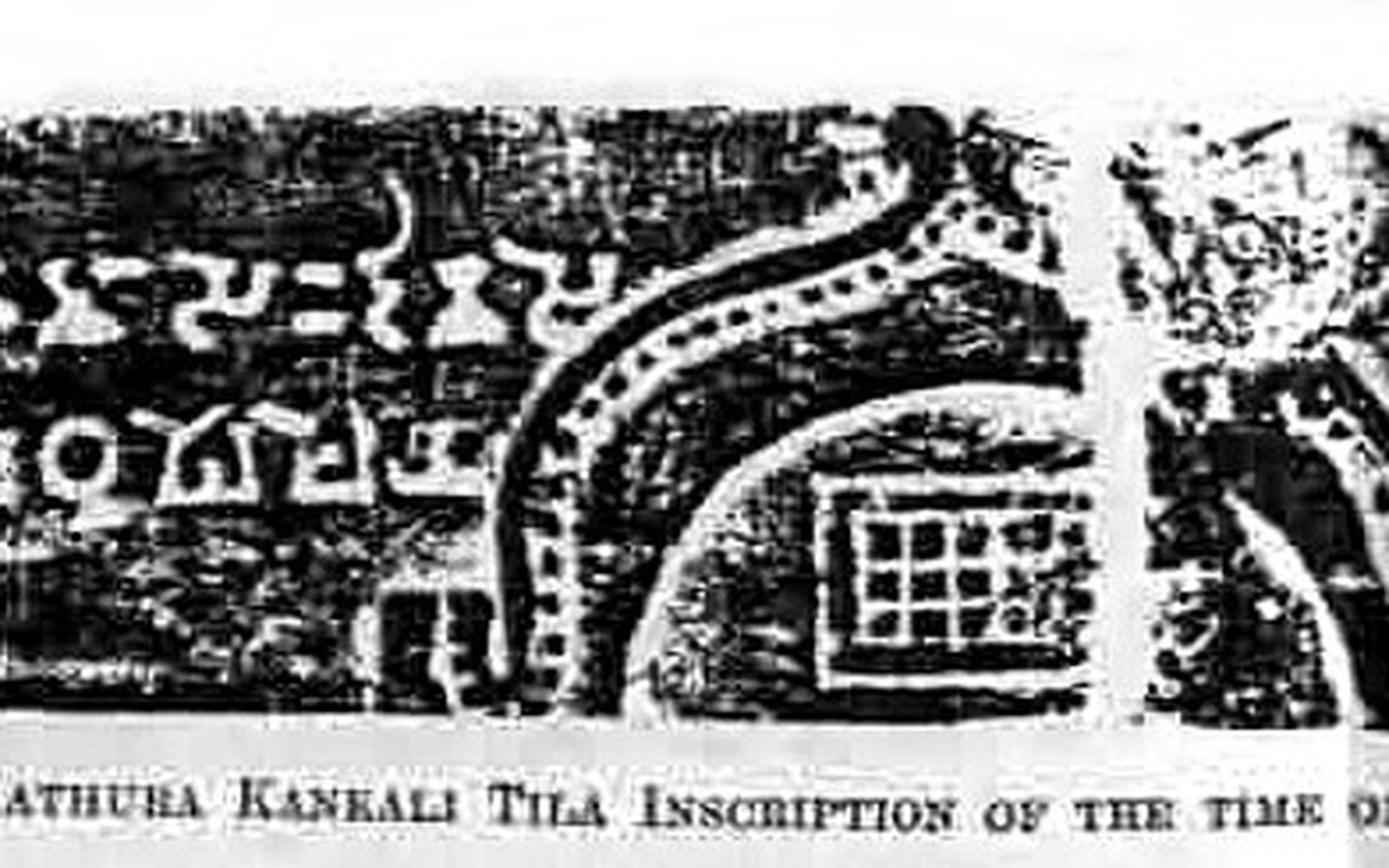
Sculptural evidence from Kankali Tila in Mathura, excavated under the auspices of the Archaeological Survey of India in the late nineteenth and early twentieth centuries, shows the mark in early Jain relief carving alongside the other auspicious emblems, giving the grouping a documented material history stretching back roughly two thousand years. The Mathura pieces are among the most securely dated early Jain objects in any collection.
In the manuscript tradition, the set can appear at the head of a text as a formal opening invocation — the eight marks laid out across the first folio before a word of doctrine is written. Libraries in Patan, Gujarat, preserve palm-leaf and paper manuscripts in which this arrangement survives intact, the pigments still clear enough to read each of the eight emblems in sequence.
The Victoria and Albert Museum holds examples of Jain manuscript art in which the ashtamangala fills decorative panels, and the Museum of Fine Arts Boston holds painted wooden book-covers from western India that show the same convention at the threshold of the text.
The set also organises temple ritual. Before the image of a Tirthankara is formally honored, the eight objects may be arranged in front of it as part of the puja sequence. In this context the svastika is not merely depicted — it is drawn fresh in rice or powder on a prepared surface, which ties Jain ritual practice to the broader South Asian household tradition of marks made and remade at auspicious moments.
What the ashtamangala ultimately demonstrates is that a mark which looks, from outside, like a simple geometric figure carries its meaning through membership. The set is the argument; each of the eight is one term in it. Remove any one and the statement is incomplete. Place all eight together and you have, in Jain understanding, a diagram of what the universe is and what a soul may, through right conduct, eventually leave behind.