The seal
卍 on a Japanese Map
It remains the standard cartographic symbol for a temple, printed on ordinary survey maps.

It remains the standard cartographic symbol for a temple, printed on ordinary survey maps.
The temple mark that stayed on the grid
Walk into any convenience store in Japan and buy a street map, and you will find it there: a small 卍, printed in black, sitting on the grid wherever a Buddhist temple stands. The Geospatial Information Authority of Japan — the national mapping body — uses it as the standard symbol for a tera (temple), and has done so across generations of official survey maps. It is a piece of cartographic convention so settled that most map readers register it as pure information, the way a cross registers on a European map: functional, unremarkable, exactly placed.
The symbol is the manji in Japanese, the same four-armed hooked figure that appears across Buddhist Asia under different names. In China it is read as wàn, meaning ten thousand, and carries connotations of abundance and completeness. The character appears in Buddhist sutras transmitted from Sanskrit originals, where it glosses a mark associated with the body of the Buddha — one of a set of auspicious signs said to be visible on an enlightened being.
When those texts moved through China and into Japan from roughly the sixth century onward, the character and the concept traveled together, and the mark became attached to temple architecture and sacred imagery as a matter of transmitted doctrine, not local invention.
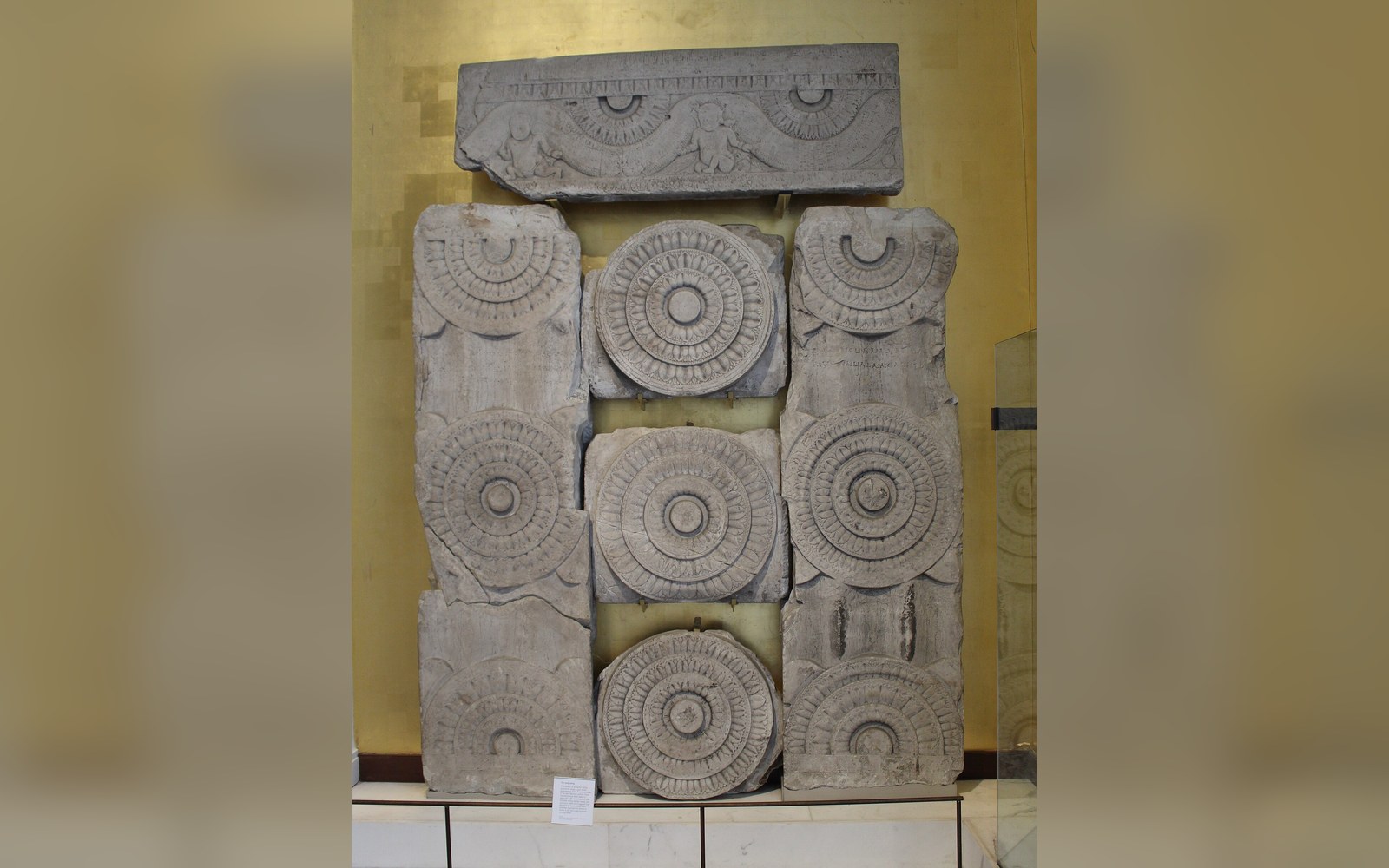
On a Buddhapada at Amaravati — a carved slab showing the soles of the Buddha's footprints — the figure appears among the marks pressed into stone in the second century CE, centuries before any of the East Asian traditions received it. The continuity of the same form across those traditions is the reason the character found a stable home in written Japanese, and eventually on a printed map.
The connection to temple buildings is direct. The manji appears on lanterns, on roof tiles, on textiles, on the covers of sutra boxes, and carved into the wooden transoms of temple gates. When Japanese cartography needed a symbol compact enough to sit inside a grid square yet unambiguous enough to be read at a glance, the manji was already the legible, agreed shorthand for Buddhist sacred space. The map is simply transcribing what the built environment already said.
The Geospatial Information Authority's topographic maps — the 1:25,000 series that covers the Japanese archipelago in fine detail — show the manji alongside shrines (marked with a torii gate symbol), churches and other places of worship, each sign keyed to its tradition. The distinctions matter: a torii marks Shinto, a manji marks Buddhist, and the two have coexisted on the same page without confusion for the map-reading public. That clarity is the product of a cartographic culture accustomed to the symbol's specific meaning.
Japan is not alone in this convention. The South Korean national mapping authority similarly uses the figure for Buddhist temples on its standard topographic sheets. Across several East Asian countries the mark functions as a cartographic unit within national geographic information systems, each country's usage rooted in the same transmitted Buddhist vocabulary.
What the Japanese map preserves, then, is a moment of translation frozen in convention. The mark began as a physical description — a sign on the body of the awakened one, later pressed into footprint slabs and woven into fabric — and became, through centuries of textual and artistic transmission, a shorthand for the institution that kept those objects and that teaching. The cartographic symbol inherits all of that compression. It does not explain itself on the page because, within the tradition from which it comes, it does not need to.
The map is also a kind of archive. Temples in Japan have been established, burned, rebuilt and relocated over more than a millennium, and the survey map captures their present positions with the same dispassion it brings to road junctions and contour lines. Each manji marks a living institution and a long practice. The symbol's age — its root in second-century stone carvings, its passage through Chinese sutras, its absorption into Japanese sacred architecture — is not visible on the grid, but it is the reason the mark is there at all, still legible, still exactly placed.