The seal
Buddhapada at Amaravati
The Buddha's footprints are carved with marks on the soles, and the excavated slabs at Amaravati are where that convention is clearest.
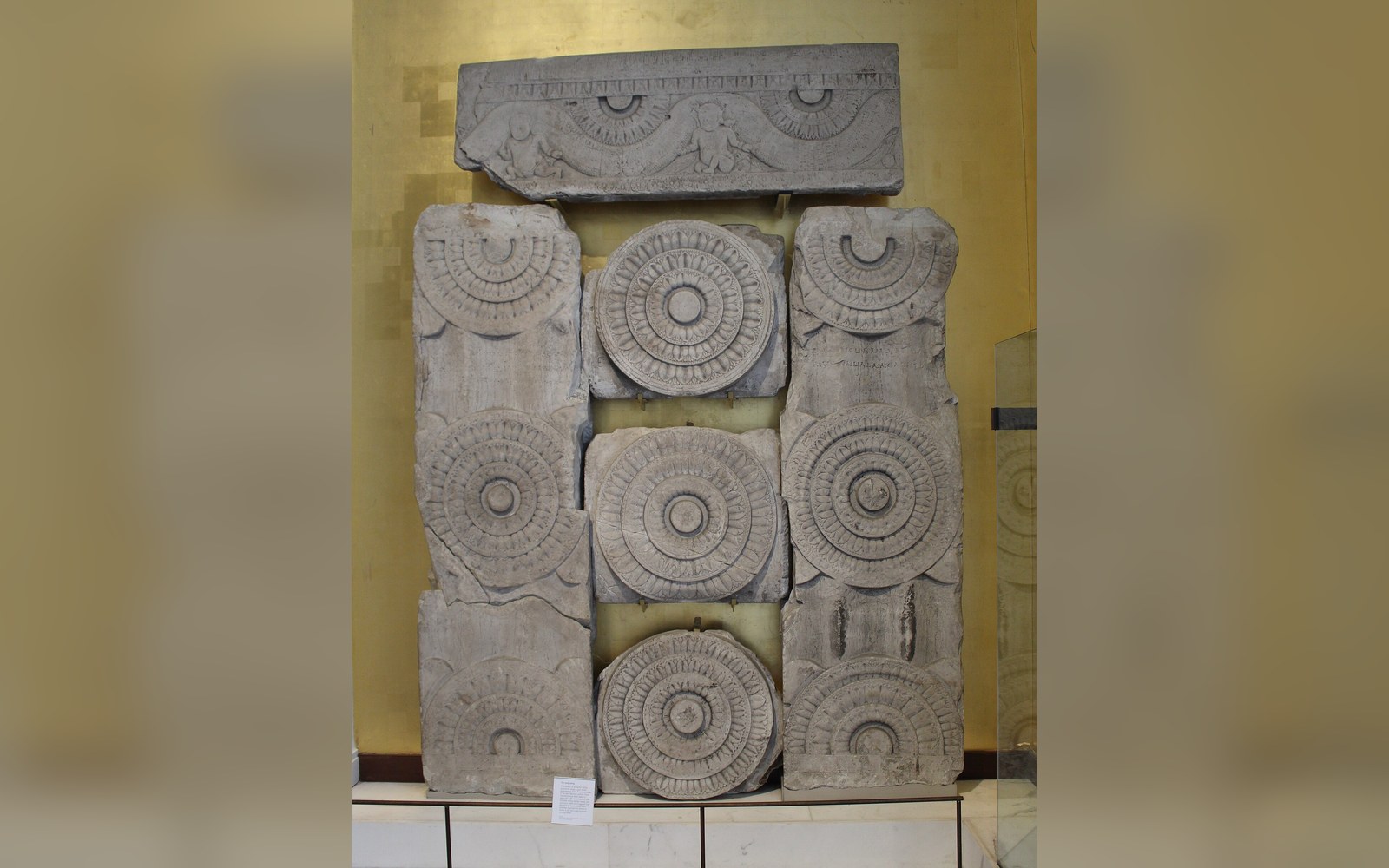
The Buddha's footprints are carved with marks on the soles, and the excavated slabs at Amaravati are where that convention is clearest.
The foot that stands for the whole
A carved stone slab shows two feet, side by side, soles facing the viewer. No body rises above them. No face looks out. The feet alone are the devotional object, and on the soles — incised, sometimes inlaid — a cluster of marks: a wheel at the center of each sole, a fish pair, a conch, a vase, a fly-whisk, and among them, the figure with four arms turning from a central square. This is the buddhapada, the Buddha's footprint, and the slabs recovered from the great stupa at Amaravati, Andhra Pradesh are among the finest surviving examples of the tradition.
The convention rests on a theological premise: the Buddha's body is gone from the world, but the impression of his presence remains. Early Buddhist visual practice, particularly before the anthropomorphic image became standard, preferred this logic of the trace. A wheel in the stone stands for the turning of the dharma. An empty throne, a parasol, a tree — these are the Buddha's proxies, not his likeness.
The footprint fits the same grammar. What is marked on the sole is not decorative; each sign belongs to the vocabulary of auspicious marks inherited from the broader Indic visual tradition, and the set that appears at Amaravati reflects the ashtamangala — the eight auspicious things — or partial versions of it, drawn together into the space of the sole as a field of accumulated merit.
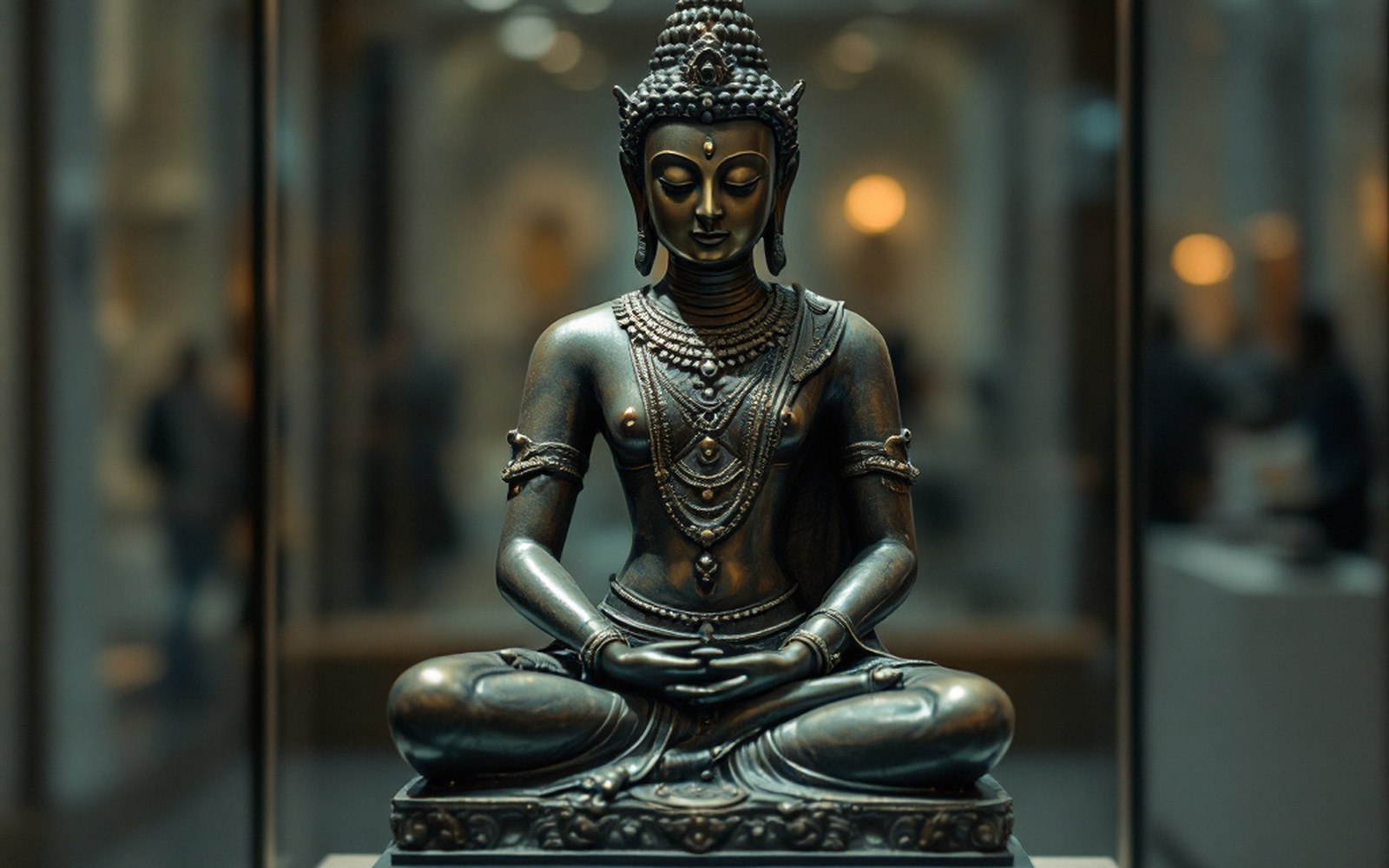
Amaravati and its excavated slabs

The stupa at Amaravati was one of the largest in the ancient world, and its sculptural program, carved primarily in white limestone between roughly the second century BCE and the third century CE, was among the most ambitious.
Excavations in the early nineteenth century by Colin Mackenzie and later by Walter Elliot brought hundreds of relief slabs to light; the finest groups are now held by the British Museum and the Government Museum in Chennai. The slabs illustrate narrative scenes, worship at the stupa itself, and at intervals — carved with particular deliberateness — the buddhapada panels.
What distinguishes the Amaravati footprint slabs is the density and legibility of the sole-marks. The craftsmen worked a creamy, fine-grained limestone that allowed sharp incision, and they arranged the marks in registers across the sole rather than scattering them. The dharmachakra, the wheel of the law, anchors the center. Around it, the other marks occupy defined positions, giving the sole the quality of a diagram as much as an image.
The figure with four turning arms appears in this field not as an isolated emblem but as one term in a coordinated system. Its presence here is consistent with its presence on the soles in the broader tradition: it is, in this context, an auspicious mark in the technical sense — a sign whose placement accumulates and radiates wellbeing.
The worshipper approaching the slab would have understood the sole not as an illustration of what a foot looks like but as a map of qualities. To bow before the buddhapada was to come into proximity with those qualities simultaneously. The marks on the sole made that proximity legible.
What the marks mean on the sole
Identifying what each mark signifies requires care, because the ashtamangala is not a fixed list: its membership varies between early Buddhist, later Mahayana and Theravada contexts, and the marks on individual footprint slabs vary accordingly.
At Amaravati the iconographic repertoire belongs to a relatively early phase of systematization, and the pairing of certain signs — the two fish, the wheel, the figure with four arms — can be read against later textual lists while acknowledging that those lists may not be the source. The visual tradition at the stupa preceded the textual codifications that later scholars have used to interpret it.
The four-armed figure carries, in this context, no specific doctrinal label; it is an auspicious mark, one element in a field of auspicious marks, and its meaning is relational rather than singular. It signals good fortune, right-turning motion, the concentration of beneficial force.
A Buddhist commentary does not need to be invoked to explain why it appears here: the mark was known across the visual culture of the period as a sign of this general class, and its placement on the sole of the Buddha's footprint places it in service of a specific devotional claim — that standing where the Buddha stood, or bowing to the trace he left, participates in the accumulation of merit.
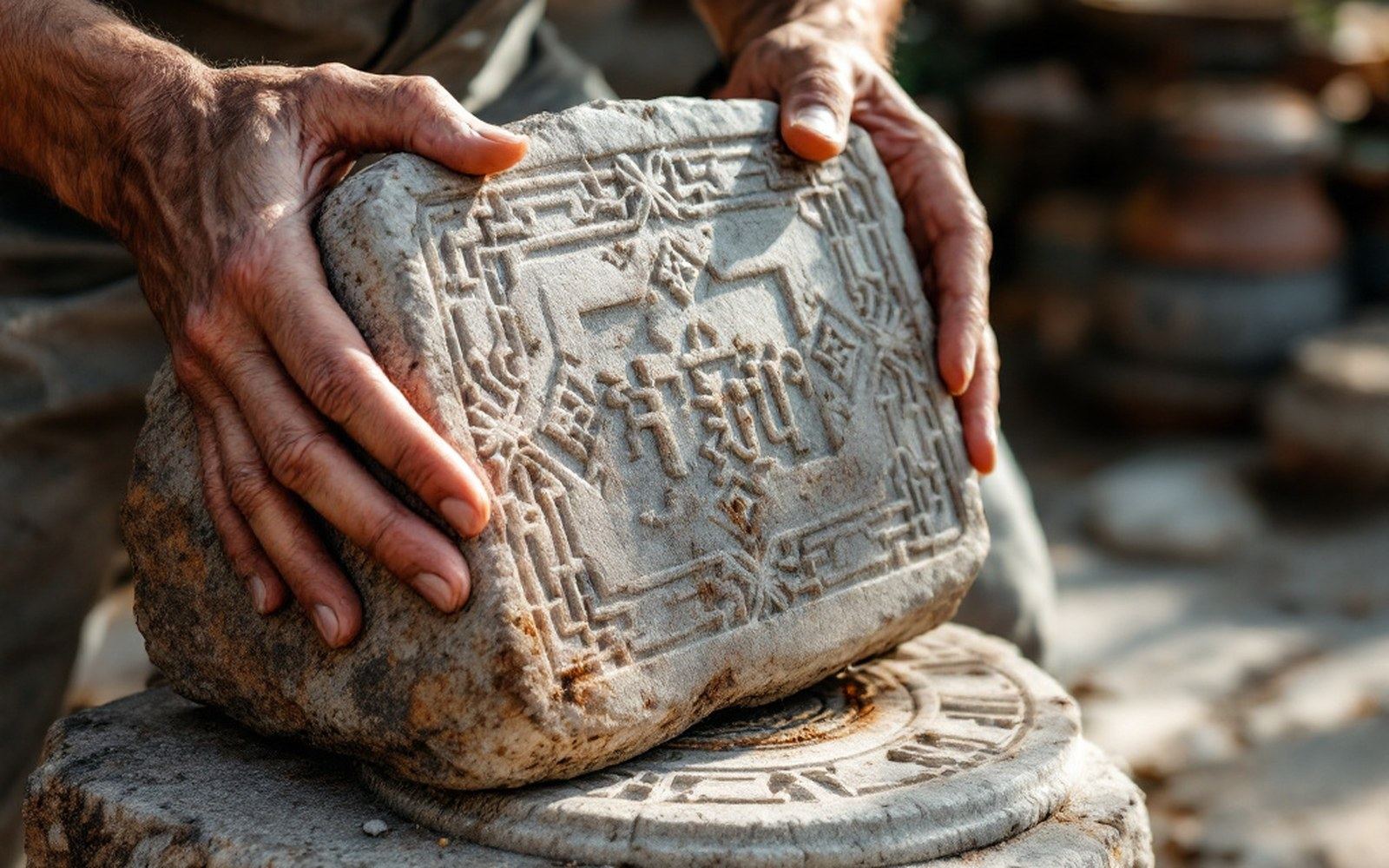
Devotion to the trace
The buddhapada tradition spread beyond Amaravati. Footprint slabs are known from Gandhara in the northwest, from Sri Lanka, from Thailand and from China, each regional version inflected by local visual conventions while maintaining the core structure: the foot, the sole, the cluster of marks. The Museum of Fine Arts Boston holds examples from Gandharan workshops that show the sole-marks in relief rather than incision, giving them a different surface quality; the British Museum's Amaravati collection preserves the incised version in its cleanest form.
At Amaravati specifically, the buddhapada slabs appear to have been positioned at points of circumambulation — the pradakshina path around the drum of the stupa — where devotees would encounter them in sequence during worship. The spatial logic reinforces the devotional one: the marks on the sole are encountered by a moving body, a body performing merit-accumulation through the act of circumambulation itself. The diagram in stone and the act in space are complementary.
John Marshall, whose work with the Archaeological Survey of India shaped the excavation of so many South Asian sites, wrote about the difficulty of reading auspicious marks in isolation from the monuments that carried them. The Amaravati slabs make that point concretely. The four-armed figure on the sole means something here because of what the sole is, what the foot represents, and what the building once asked of the person standing before it.