The word
Thresholds, rangoli and kolam
Drawn fresh each morning in rice flour at the entrance to a house, swept away and drawn again — a practice rather than an ornament.
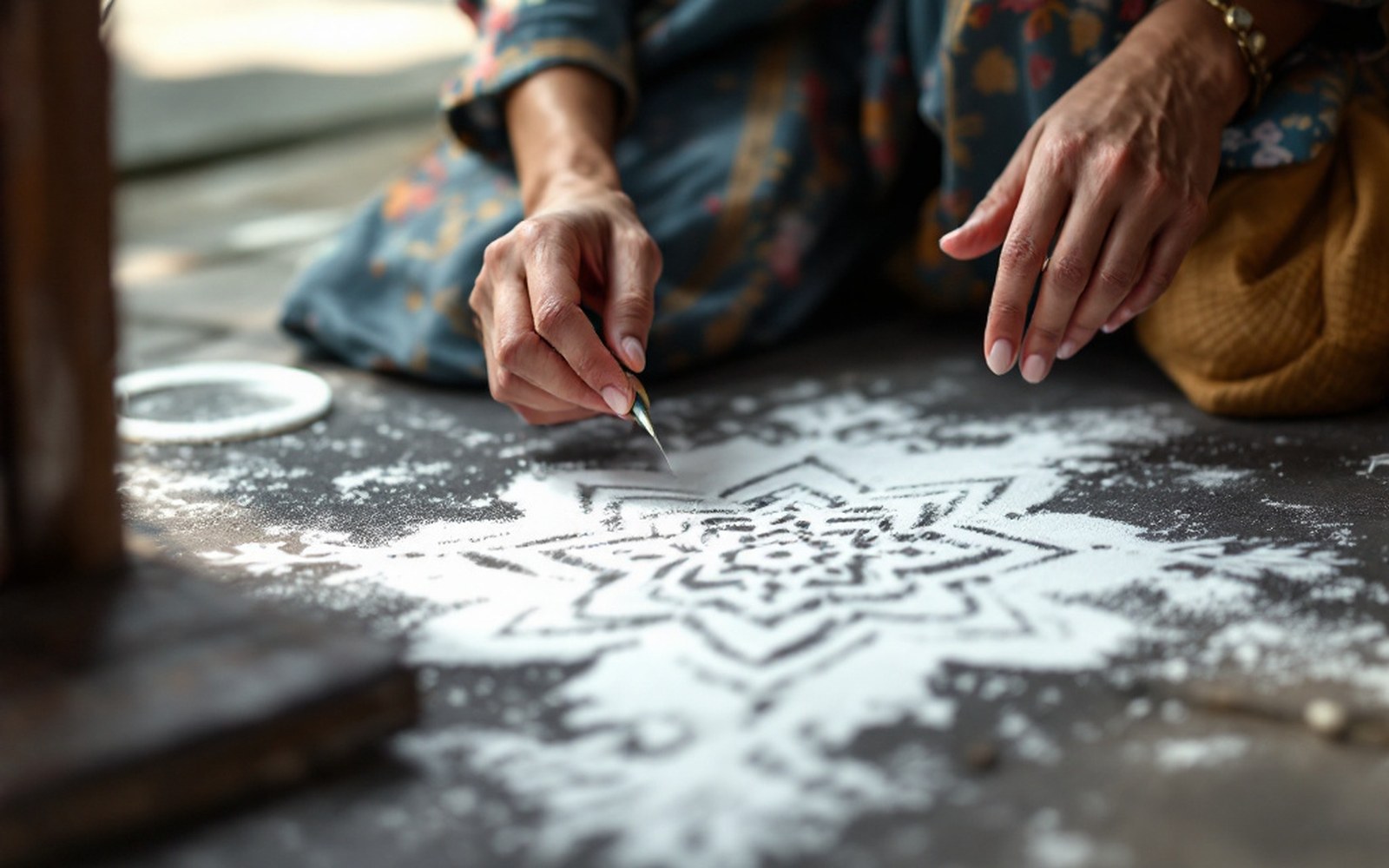
Drawn fresh each morning in rice flour at the entrance to a house, swept away and drawn again — a practice rather than an ornament.
A mark that lives for one day
The floor at the entrance to a South Asian household is not decorated once and left. Before sunrise — in many families, after the threshold has been swept clean and the ground dampened — a woman of the house kneels or crouches and lays down a pattern in white rice flour or ground rice paste, working freehand or following a grid of dots placed first. By midday it is blurred by foot traffic. By evening it is gone. The following morning she draws it again.
This is the practice. The object it produces is not meant to last, and its transience is part of its meaning. Rangoli — the Hindi and Marathi word for the tradition across much of north and west India — and kolam, the Tamil term for its southern counterpart, are not interchangeable in every detail, but they share a fundamental character: they are acts performed at a threshold, renewed daily, and understood by those who make them as auspicious, as drawing in what is good and deflecting what is not.

What the threshold means
The entrance to the house is a liminal surface in Sanskrit cosmological thought: neither inside nor outside, neither fully domestic nor open to the street. What crosses that line — guests, air, light, fortune — enters from the world. Marking it is a way of shaping what that crossing means. A plain threshold is an unguarded one; a marked threshold is an invitation that carries conditions.
The mark most commonly placed there is not always the form Westerners would recognise from museum cases. Rangoli patterns include lotuses, peacocks, geometric lattices, and complex interlocking figures that fill the whole approach to the door. But the hooked, rotating cross — the figure whose Sanskrit name reads roughly as conducive to wellbeing — appears within these traditions as a recurring element, drawn alone or embedded in a wider composition, and understood by the women who draw it as one of a set of marks with specific protective and welcoming force.
The word rangoli derives from the Sanskrit rangavalli, meaning a row or creeping vine of colour. In Tamil-speaking households the kolam has its own formal principles: it is typically drawn as a continuous line that loops without a break around a grid of dots called pulli, and its completeness — the unbroken line — carries meaning in itself. Where the kolam includes a rotational figure, it is drawn so that the line returns to its origin.
Rice flour as medium
The choice of material is not incidental. Rice flour is white, highly visible against a swept clay or stone floor, and it is edible. Feeding the ground — and, by extension, the small creatures that live near it — is understood within the practice as a form of generosity, a giving-out that creates the conditions for receiving. The flour dissolves in rain or dew and is absorbed; nothing is wasted; the ground takes back what was placed on it. In some households, coloured powders are added for festival occasions, but the daily practice is overwhelmingly white on dark ground.
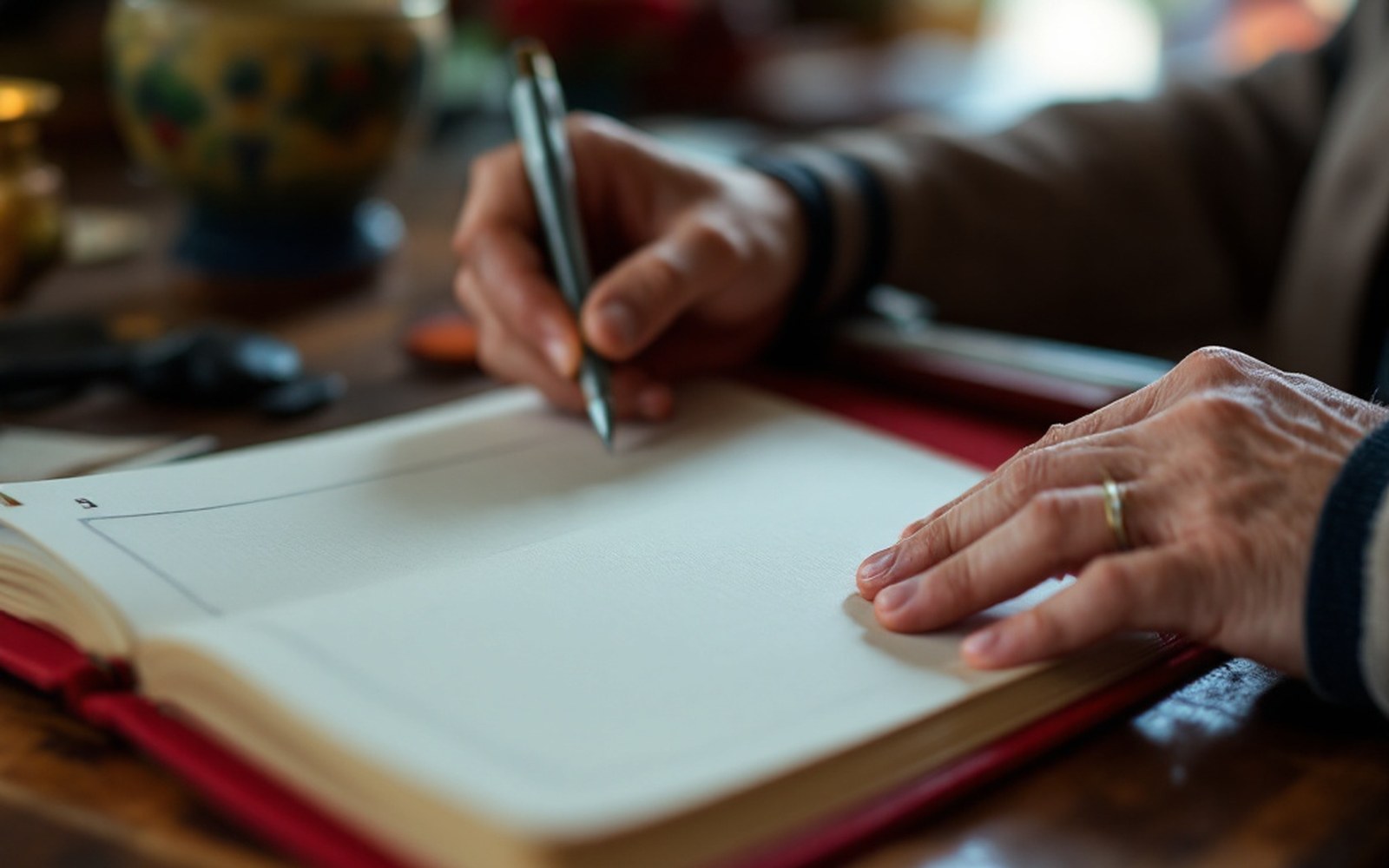
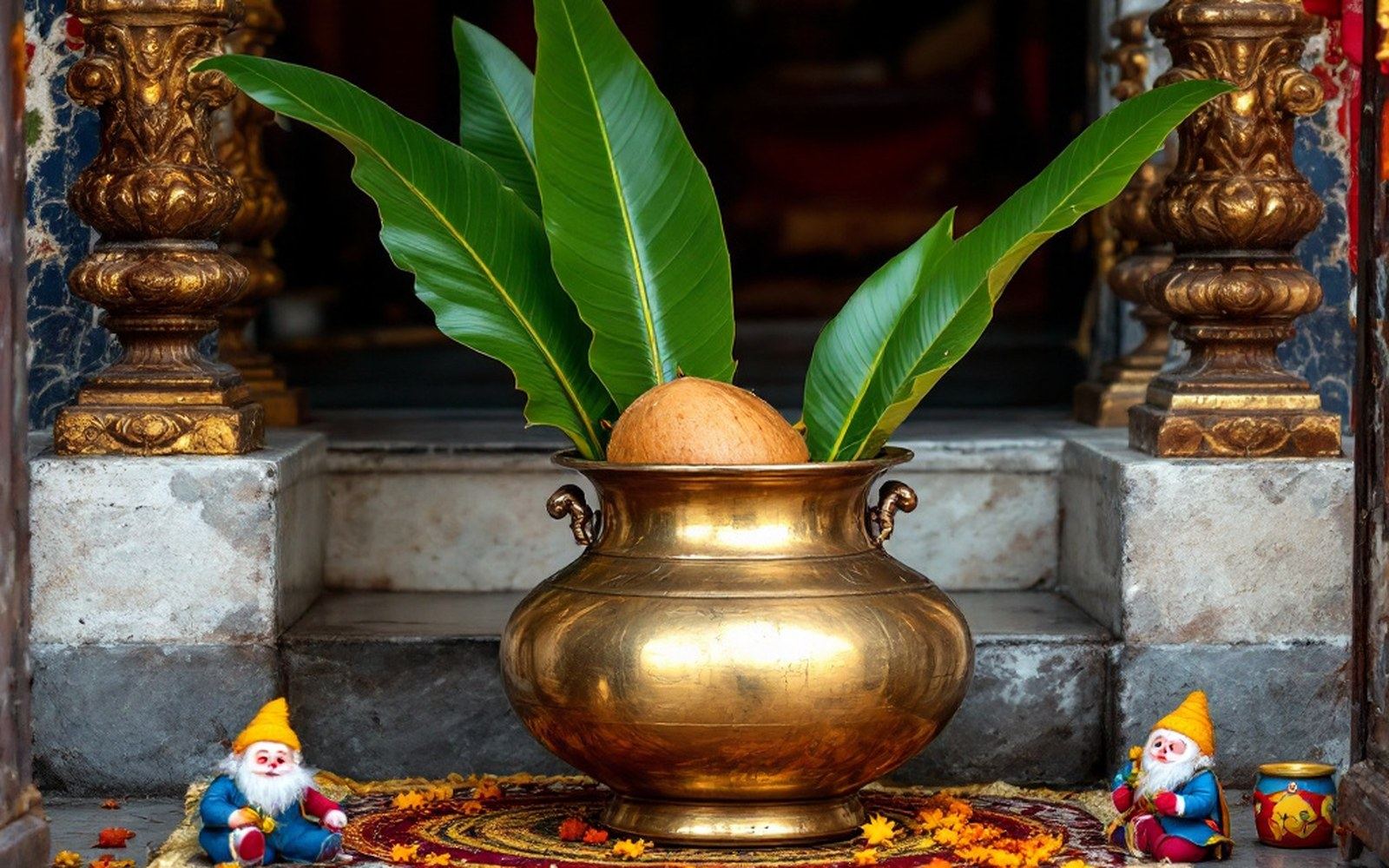
The same logic connects kolam and rangoli to the broader category of auspicious marks drawn, placed, or stamped in domestic contexts — the new account book opened at Diwali, the pot set in the doorway at a wedding. In each case the mark is made fresh at the moment it is needed and at the site where it is to act. The threshold drawing is simply the most frequent instance: daily need, daily renewal.
A practice, not a craft object
This distinction matters for how the tradition is read and misread. Because the marks are ephemeral, they left almost no material trace before photography. There are textual references — Sanskrit manuals of domestic conduct, regional ritual texts — that describe the laying of auspicious marks at entrances, but the drawings themselves vanished each day. What survives from before the nineteenth century is prescription and reference, not the marks themselves. The tradition is therefore one of those cases where a continuous, living practice is far older than any datable example.
The Archaeological Survey of India, John Marshall's excavations at Mohenjo-daro in Sindh, and the long record of auspicious marks on Indus Valley seals and objects show that rotating cross figures were present in the subcontinent at least as far back as the third millennium BCE.
Whether those marks stood in any direct lineage with the floor drawings made four thousand years later is not something the archaeology can confirm. What it shows is that the form has been used continuously in the region across an enormous span of time, across media as different as carved steatite seals and rice flour on a damp threshold.
Regional variation and the persistence of form
In Gujarat and Rajasthan, rangoli at the threshold is often supplemented by painted footprints — the feet of Lakshmi, goddess of prosperity — leading from the street into the house, so that the goddess is understood to be walking in. The auspicious mark appears at the point where those footprints begin, or at the centre of the composition that surrounds them.
In Tamil Nadu, the kolam tradition has been studied by ethnographers and art historians as a form of geometric knowledge transmitted entirely through practice: the women who make the most complex kolams carry in their heads a spatial intelligence expressed nowhere else in their daily lives. The Victoria and Albert Museum holds collected examples — photographs and pigment drawings — that document regional variety without being able to capture the act of making.
In Andhra Pradesh and Telangana, the marks at the threshold are called muggulu or muggu; in Odisha, jhoti; in Bengal, alpana. Each name belongs to a regional practice with its own conventions, its own festival calendar, its own relationship between daily and ceremonial drawing. What runs through them is the threshold, the perishable medium, and the daily repetition — a structure that makes the practice closer to a prayer than to a decoration.
The rotating cross fits naturally into this structure. It is a figure with four arms in balanced motion: directionally complete, without a point of rest, returning to itself. On a threshold, a mark like that does not merely fill space. It enacts, in the terms of the tradition, exactly what the threshold is for.