The word
The word: su + asti + ka
The Sanskrit reads roughly as conducive to wellbeing — a description of what the mark is for rather than a story about what it depicts.

What the Sanskrit actually says — and why a name that describes a function rather than a shape tells you something important about the tradition that coined it.
The parts of the word
Sanskrit is a language of roots and suffixes, and svastika breaks apart cleanly. The prefix su means good or well, in the same family of sense as the Greek eu in euphoria or eulogy. The root asti comes from the verb as, to be — cognate with Latin est and English is, all of them descendants of the same Proto-Indo-European stem.
Together, svasti means wellbeing, good fortune, a state of things going well. The suffix ka is a common Sanskrit nominalising particle, turning an abstract into a concrete noun or object. So svastika is, with reasonable literalness, a thing conducive to wellbeing — an object, a mark, a token of good fortune rather than a representation of any particular deity, story or cosmic diagram.
That distinction matters. Across many traditions, a sacred mark is understood as an image of something — a deity's attribute, a cosmological structure, a moment in a narrative. The Sanskrit word for this one makes no such claim. It names the mark by what it does for the household or the person who uses it, not by what it depicts. The name is, in that sense, a functional description: this is the wellbeing-thing.
The word appears in Vedic literature long before any standardised iconographic use of the four-armed figure that modern viewers recognise. In the Atharva Veda and in a range of early Sanskrit texts, svasti is a salutation and a blessing — a word spoken at auspicious moments, the opening of a ritual, the beginning of a journey, the birth of a child. The mark and the word share a common field of meaning, but they are not identical: the word is older in documented use, and the mark, when it appears, inherits the word's established sense.
What the name tells us about use

Because the name describes a function rather than a fixed iconographic content, the mark was applied with considerable flexibility across traditions that accepted the Sanskrit vocabulary. In Jain usage, it became one of the ashtamangala — the eight auspicious things — where it sat alongside the full water pot, the fish, the mirror and four other symbols, each carrying its own freight of meaning within a set.
In that context the mark's Sanskrit name aligned naturally with the set's overall logic: these were things that signified, and perhaps helped bring about, a state of auspiciousness. The mark was not renamed; it was placed.
Buddhist texts adopted both the word and the figure, associating the mark with the buddhapada — the footprint of the Buddha — where it appears among the signs on the sole, alongside the wheel and the lotus. Here again the name's functional sense was capacious enough to absorb the new theological setting: wellbeing, in a Buddhist frame, could include liberation from the cycle of rebirth, which is the highest form of things going well.
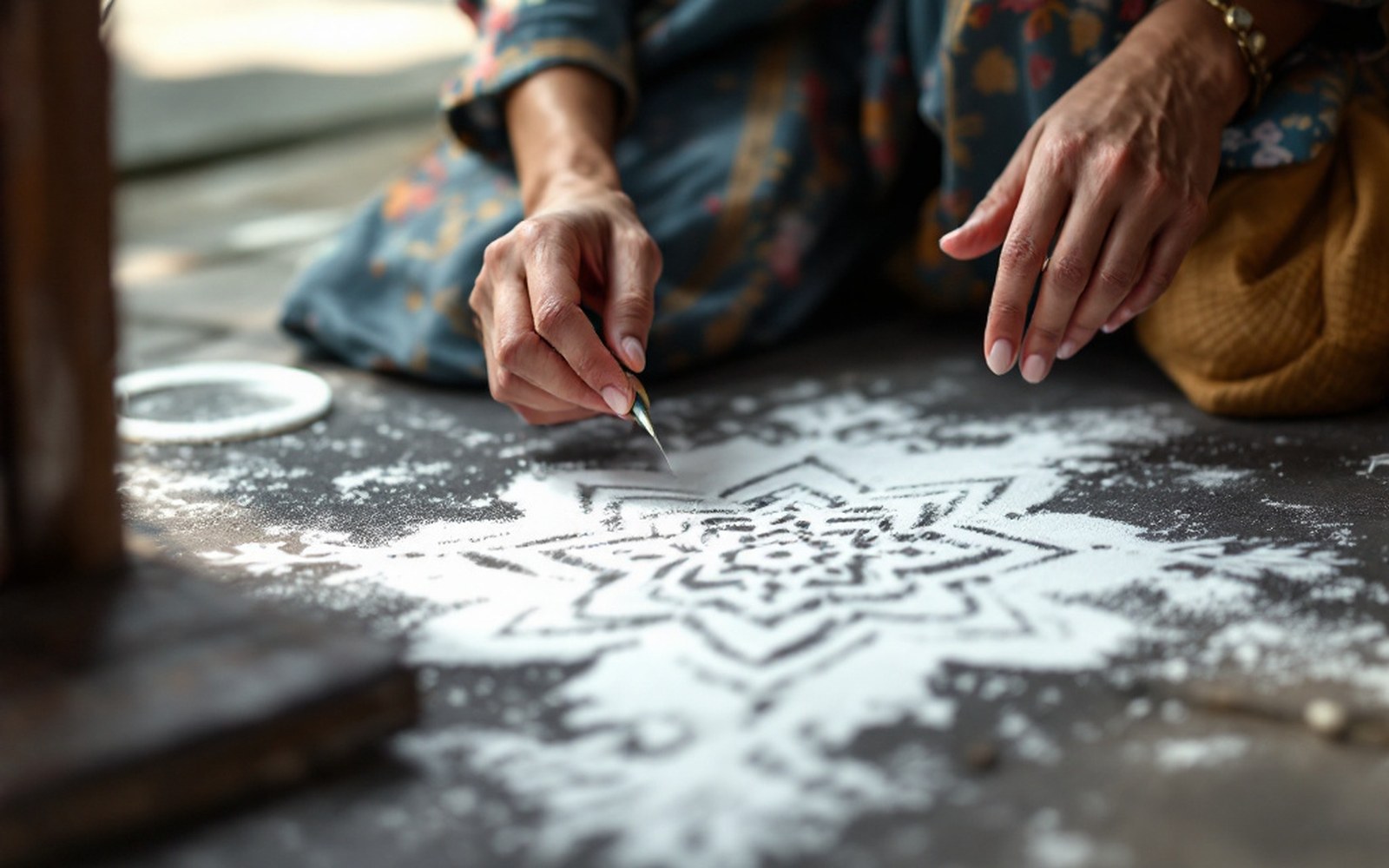
In domestic Hindu practice the word's meaning is felt most directly. Painted in red powder or turmeric on a threshold, on a new ledger opened at Diwali, on the forehead of a child, on the flank of a cow, the mark acts in precisely the way its name says: it marks something as under the sign of wellbeing, oriented toward good fortune.
The rangoli and kolam traditions of threshold drawing — still practised daily across South Asia — operate in this same semantic field, and the mark sits within them not as an emblem requiring explanation but as a familiar guarantor of auspiciousness whose name everyone already knows. The scholarly literature on this household use traces a remarkably stable functional continuity across centuries of documented practice.
The mark and the word in the archaeological record
The figure itself appears in the archaeological record well before any written Sanskrit source can be attached to it. At Mohenjo-daro in Sindh and at Harappa in Punjab — excavated under the direction of John Marshall and Ernest Mackay for the Archaeological Survey of India in the 1920s — steatite seals and small fired-clay objects carry the mark among a repertoire of signs whose language, if it is a language, has not been read.
What those marks meant to the people of the Indus Valley Civilisation around 2500 BCE is not recoverable from the objects alone. The connection between those marks and the Sanskrit word svastika is a hypothesis of cultural continuity, not a demonstrated chain: there is a gap of centuries in the record, and the Indus script remains undeciphered.
That caution is not a reason to dismiss the archaeological material — it is a reason to read it on its own terms. The seals from Mohenjo-daro show a mark placed among other signs on a carefully made object of evident significance. Whether the word svastika would have meant anything to the person who cut that seal cannot be said. What can be said is that when the word enters the documented Sanskrit record, it is already associated with wellbeing, and the mark later takes on that sense, and that relationship is built around function — around wellbeing — rather than around a specific narrative or deity.
A name that travels
The word svastika passed from Sanskrit into Pali and the Prakrits that carried Buddhist and Jain teaching across South and Southeast Asia. Wherever those traditions established themselves, they carried both the mark and its name, and the name's functional meaning translated readily because wellbeing is a concept that requires no culture-specific story to make it intelligible.
In Tibetan Bon practice the cognate figure is called yungdrung — a distinct term in a distinct tradition — which is a reminder that the Sanskrit word was not universal even in the regions where the shape appeared; meaning was always local, always the product of a specific tradition's vocabulary.
The Greek and Roman decorative traditions that used comparable four-armed and hooked figures had their own terms — the meander, the gammadion — and there is no reason to suppose the Sanskrit sense travelled with the shape into the Mediterranean world. The word and the mark are separable. The mark is a shape; the word is an interpretation. What the Sanskrit word svastika preserves is one tradition's decision about what the mark is for: not a picture of something, but a guarantor of something, named for the condition it was meant to bring about.