The word
Wedding Cards and the Kalash
It appears on invitations and on the pot set at the doorway, in contexts that are domestic rather than temple.
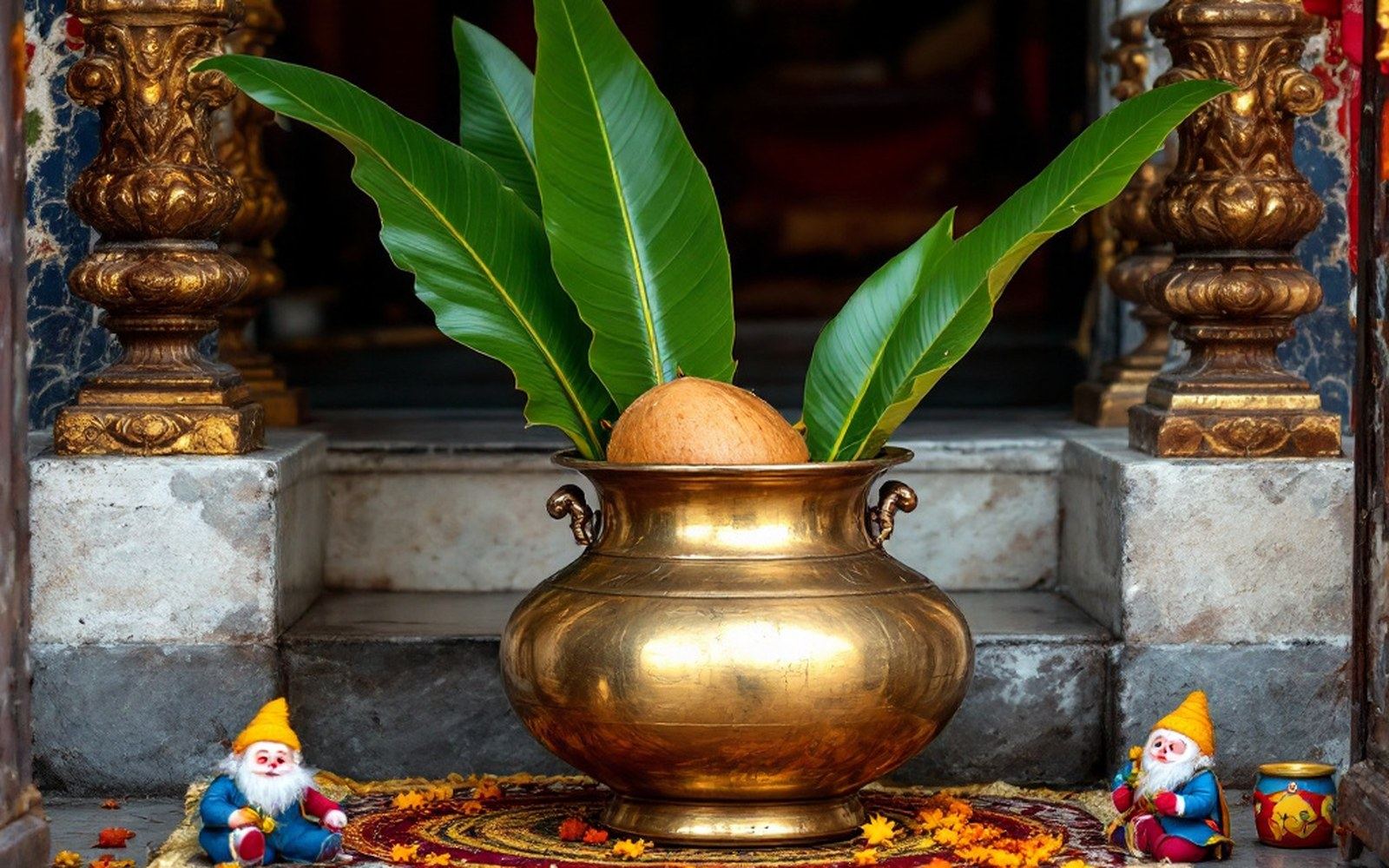
Where the mark lives in the domestic event — the printed invitation, the clay pot at the threshold, the household ritual that needs no priest to explain it.
The Domestic Register
A Hindu wedding invitation printed anywhere from Rajasthan to Tamil Nadu will often carry the mark before any other image — before the couple's names, before the date. It sits at the top corner of the card the way a capital letter opens a sentence: as orientation, as the signal that what follows is auspicious. The word itself tells you as much. Su + asti + ka reads in Sanskrit as conducive to wellbeing, and that is exactly the function it performs on the card — not decoration but declaration.
The kalash, a rounded clay or brass pot filled with water and topped with a coconut and mango leaves, is set at the entrance of a house when a wedding or major ceremony is underway. The mark is painted or scratched onto its side, again as a statement of intent rather than as ornament. The pot is understood to embody fullness and good fortune, and the mark on its body doubles the claim. Neither element requires temple architecture or priestly apparatus to make it legible; both are household literacy, passed through families.
This domestic confidence — the sense that the symbol belongs to ordinary people using it in ordinary circumstances — is documented in material as old as the Indus Valley. Steatite seals excavated at Mohenjo-daro in Sindh and at Harappa in Punjab by John Marshall's Archaeological Survey of India teams beginning in the 1920s show the figure in a context that is civic and commercial rather than purely cultic. Whatever its precise meaning at that horizon, it was clearly not reserved for specialists. It moved through daily life.
The same pattern holds in the threshold arts. In many parts of South India a kolam — a geometric figure drawn each morning in rice flour at the entrance to the house — incorporates the form as one possible figure among many, renewed daily and then erased.
The Victoria and Albert Museum holds examples of rangoli stencils and documentation of kolam practice that illustrate how thoroughly the mark belongs to this domestic, repeated, perishable register. Nothing about the wedding card or the painted kalash is exceptional; they are part of the same long habit of placing an auspicious mark at a threshold — literal or figurative — before something important begins.
What the wedding card and the kalash share with the drawn threshold is the logic of timing: the mark goes on before. It is placed at the opening, which is precisely what the Sanskrit etymology promises — not a record of good fortune already received, but a considered act of welcome toward it.